






Before comparing plans on Your Health Idaho, check the answers that determine your tax credit: your tax household, expected 2027 income, access to coverage through work, and eligibility for Medicaid or CHIP. An error in those answers can change the monthly price you see or leave you with advance credits to repay at tax time.
“There’s two or three questions that if they answer wrong, they don’t get a tax credit, and I see that all the time. The very first thing I’ll do is look at the three or four key questions.”
— Kyle Bennett, Eagle Cap Insurance
When I review an application, I start with those answers. Comparing premiums is more useful once we know which financial help the household qualifies for.
You can preview Your Health Idaho’s 2027 plans October 1 to 14. Open enrollment runs October 15 through December 15, 2026, for coverage starting January 1, 2027. Idaho uses a different calendar from HealthCare.gov. Our Idaho open enrollment guide covers dates, renewals and deadlines; the questions below focus on the tax credit.
Two changes that affect your 2027 tax credit
The enhanced federal subsidies ended after 2025. Separately, the cap on repayment of excess advance credits was removed starting with tax year 2026. Both changes make it important to keep your income estimate current.
The 400% cliff is back. From 2021 through 2025, extra federal help reached households above 400% of the federal poverty level (FPL). That expired after 2025. The IRS tables for 2026 and 2027 stop at 400% FPL, and above that line there’s no premium tax credit at all (IRS Rev. Proc. 2026-26). The House passed a three-year extension (H.R. 1834) in January 2026. As of October 2026 it hasn’t become law. If Congress acts, these numbers change.
There’s no longer a cap on paying it back. Your credit is usually paid in advance each month, based on the income you estimate. At tax time you settle up. There used to be a limit on how much extra credit you’d owe back if your income came in higher. A 2025 federal law, Pub. L. 119-21 §71305, removed that limit for tax years beginning after December 31, 2025. If your real income beats your estimate, you can owe the full difference.
If your income changes during the year, update the application rather than leaving the original estimate in place.
Six application questions to review
Household size and income determine where you fall on the federal poverty-level table. The remaining questions help determine whether you can receive a credit and whether the advance payments need to change.

1. How many people are in your household?
Start with your tax household. The income cutoff changes with household size. For 2027 coverage, the 400% poverty-level cutoff is $63,840 for one person, $86,560 for two, $109,280 for three and $132,000 for four.
Don’t simply count everyone living in your home. A grown child who files independently, a partner you don’t file with or a parent living with you may be treated differently for tax purposes. Ask for help if you’re unsure who belongs in the household count.
2. What is your expected household income for 2027?
The credit uses estimated household income for the coverage year, measured as modified adjusted gross income (MAGI). Use your prior tax return and current pay as a starting point, then account for changes you expect in 2027.
A raise, overtime, a spouse returning to work or more income from a side business can make last year’s figure a poor estimate.
For example, suppose a married couple estimates $84,000 for 2027. That puts their two-person household below the $86,560 income cutoff. One spouse takes a second job in June, and their final income reaches $90,000. They are now above 400% FPL. Under the rules described here, they would no longer qualify for a credit for the year, and the advance credits paid on their behalf could be due back with their tax return. These numbers are illustrative.
Reporting the new income in June would let Your Health Idaho adjust later advance payments, reducing the amount that could need to be repaid.
3. Does anyone in the house have an offer of job-based coverage?
Answer this for everybody, including offers you turned down. If an employer offers you coverage that counts as affordable and meets minimum value, you generally can’t get a Marketplace credit for yourself. For plan years starting in 2027, it’s “affordable” if your share for self-only coverage is no more than 10.22% of household income.
Your family is tested differently. Since 2023, under the IRS “family glitch” fix, affordability for your spouse and kids is measured on what it costs to cover you and them. If family coverage through work runs over 10.22% of household income, they may qualify for a credit even though you don’t.
Declining an employer’s plan doesn’t erase the offer for eligibility purposes. Also, affordable coverage for the employee doesn’t necessarily mean affordable coverage for the family. Get the employer’s prices for employee-only and family coverage before answering. Our group vs. individual health insurance comparison explains the options.
4. Could anyone qualify for Idaho Medicaid or CHIP?
The application also checks eligibility for Medicaid and CHIP. Idaho Medicaid covers expansion adults ages 19 to 64 up to 138% FPL. The Idaho Department of Health and Welfare’s 2026 chart lists $1,836 a month for one person, plus $654 for each added household member. Idaho CHIP covers children up to 185% FPL, which DHW lists as $3,427 a month for a household of two, plus $900 for each added member.
Children may qualify for CHIP while their parents qualify for a Your Health Idaho plan. Report the household’s income accurately even when the result is different coverage for different family members. If you’re enrolled in Medicaid expansion, watch for notices: Idaho must start work and community-engagement requirements by December 31, 2026, and federal rules move expansion adults to six-month renewals in 2027. Our Idaho Medicaid and CHIP guide covers eligibility.
5. Has anything changed since you applied?
Report income changes, marriage or divorce, a new baby, access to coverage through work and a move promptly. These changes can affect the credit you qualify for. Updating the application lets Your Health Idaho adjust advance payments during the year. You can reach them at 855-944-3246.
Some of those events also open a special enrollment period. You usually have 60 days to act, and Your Health Idaho allows 60 or 90 days depending on the event, with proof required. Our special enrollment guide lists the qualifying events.
Waiting until you file your taxes leaves less opportunity to correct advance payments during the coverage year.
6. Are you using the rules for the correct coverage year?
Advice from an earlier year may no longer apply. A neighbor who received a credit above 400% FPL in 2024 was covered by the enhanced-subsidy rules that have since expired.
For 2027, the IRS sets the share of income you’re expected to pay toward a benchmark silver plan before the credit covers the rest:
| 2027 household income (% of FPL) | Expected share of income |
|---|---|
| Under 133% | 2.15% |
| 133% to under 150% | 3.23% to 4.3% |
| 150% to under 200% | 4.3% to 6.78% |
| 200% to under 250% | 6.78% to 8.66% |
| 250% to under 300% | 8.66% to 10.22% |
| 300% to 400% | 10.22% |
| Above 400% | No credit |
Source: IRS Rev. Proc. 2026-26, §3.01.
Your 2026 credit won’t necessarily predict your 2027 credit. Both the contribution percentages and the poverty guidelines used in the calculation changed.
The 2027 numbers behind these questions
For 2027 coverage, Your Health Idaho uses the 2026 HHS poverty guidelines, the ones in effect when open enrollment starts. If you see $62,600 or $128,600 in a national article, that’s last year’s math.
| Household size | 100% FPL | 400% FPL (tax credit cutoff) |
|---|---|---|
| 1 | $15,960 | $63,840 |
| 2 | $21,640 | $86,560 |
| 3 | $27,320 | $109,280 |
| 4 | $33,000 | $132,000 |
| Each added person | +$5,680 |
When should you call an agent instead of guessing?
If you’re unsure about household size, income or an employer’s offer, ask for help before submitting the application. In Idaho, agents assist with Your Health Idaho enrollment without charging the person enrolling.
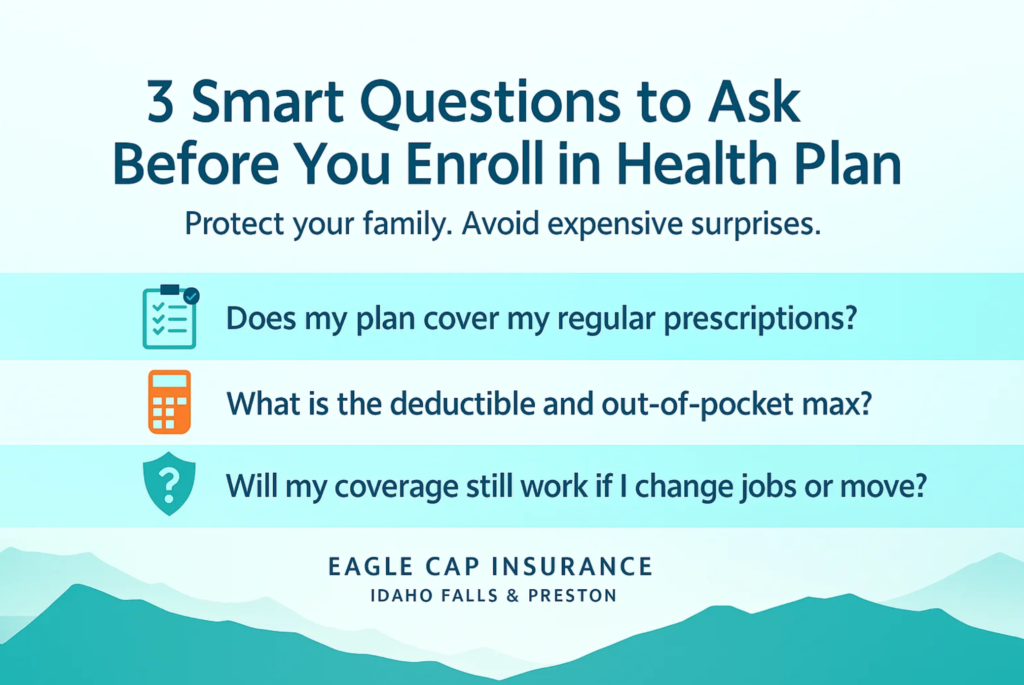
I review household and income first, then check the other eligibility questions. Once we know the available financial help, we can compare monthly premiums, deductibles and out-of-pocket limits using the figures that apply to your household.

Bring these if you have them:
- Last year’s federal tax return and recent pay stubs for every earner
- Your estimate of 2027 income, including changes you already expect
- Your employer’s monthly cost for employee-only and for family coverage
- Any renewal notice from your carrier and any letters from Idaho DHW
If you’d like to see the whole enrollment process start to finish, read our Idaho open enrollment guide for 2027.
Frequently Asked Questions
What is the income limit for a Your Health Idaho tax credit in 2027?
For 2027 coverage, premium tax credits are limited to households at or below 400% of the federal poverty level. That is $63,840 for one person, $86,560 for two, $109,280 for three and $132,000 for four, based on the 2026 HHS poverty guidelines. Income here means modified adjusted gross income for 2027. Congress could still change this, so confirm on YourHealthIdaho.org.
What happens if my income ends up higher than I estimated?
You settle up on your federal tax return. Starting with tax year 2026, the old cap on paying back excess advance credit is gone, so you can owe the full difference. If your income ends up above 400% of the poverty level, that can mean the whole credit. Report income changes to Your Health Idaho as soon as they happen so your advance credit can be adjusted.
Can I get a Your Health Idaho tax credit if my employer offers insurance?
Usually not for yourself, if the coverage counts as affordable and meets minimum value. For plan years starting in 2027, that generally means your share for self-only coverage is no more than 10.22% of household income. Your spouse and children are tested separately on the cost of family coverage, so they may qualify even when you don’t.
Do I have to pay an agent to help with my Your Health Idaho application?
No. In Idaho, licensed agents help people through Your Health Idaho at no charge to the person enrolling. Eagle Cap Insurance does this from our Ammon and Preston offices, and you can also reach Your Health Idaho directly at 855-944-3246.
To review your application with us, set up a time or call (208) 529-1522. Bring your prior tax return and an estimate of 2027 income. We can help check the answers before the December 15 enrollment deadline.
This article is general education, not tax or insurance advice, and it reflects federal and Idaho rules as of October 2026. Tax credit eligibility depends on your household’s situation; confirm with Your Health Idaho, a licensed agent or a tax professional before you act.
About the author:
Kyle Bennett leads Eagle Cap Insurance, an independent agency serving eastern Idaho since 2008 from offices in Ammon (Idaho Falls area) and Preston. He works with dozens of carriers to help individuals, families and employers with health, life, disability and business benefits.