







Losing health insurance through an employer can turn into a surprisingly complicated family decision. You may know the date your group coverage ends, but that does not automatically tell you what to buy next, whether your family qualifies for financial assistance, which documents you need, or whether everyone in the household should even be enrolled in the same plan.
That was the situation Kyle Bennett of Eagle Cap Insurance recently worked through with a young Idaho family: two parents, three children, a recent loss of group health coverage, and specific healthcare needs within the family. The entire process was handled remotely by phone. What began as a question about replacing employer health insurance became a much more useful conversation about a Special Enrollment Period, Your Health Idaho, premium tax credits, documentation, provider access, and whether different family members needed different coverage.
First Question: Did You Just Lose Health Coverage?
When the family contacted Kyle after being referred by an existing client, they were outside Idaho’s annual Open Enrollment period. That immediately changed the conversation. Your Health Idaho generally holds Open Enrollment from October 15 through December 15. Outside that window, enrollment normally requires a qualifying life event that creates a Special Enrollment Period. Loss of employer-sponsored health coverage is one of the qualifying events recognized by Your Health Idaho.
That is why Kyle’s first question was essentially, “Did you just lose coverage?” It was not small talk. It helped establish whether the family potentially had a path into Marketplace coverage outside Open Enrollment. Your Health Idaho says a Special Enrollment Period generally creates a 60-day enrollment window after a qualifying life event, although certain events can have different windows. Federal Marketplace guidance likewise says people losing job-based coverage generally have 60 days after the loss to select Marketplace coverage.
VIDEO PART 1: How Kyle Started the Special Enrollment Process
In Part 1, Kyle explains what happened next. Rather than immediately shopping for policies, he started with the family’s household: how many people needed coverage and how much income the household expected to earn. That information matters because Marketplace eligibility and potential financial assistance depend on household circumstances.
Why Income and Family Size Come Before Comparing Plans
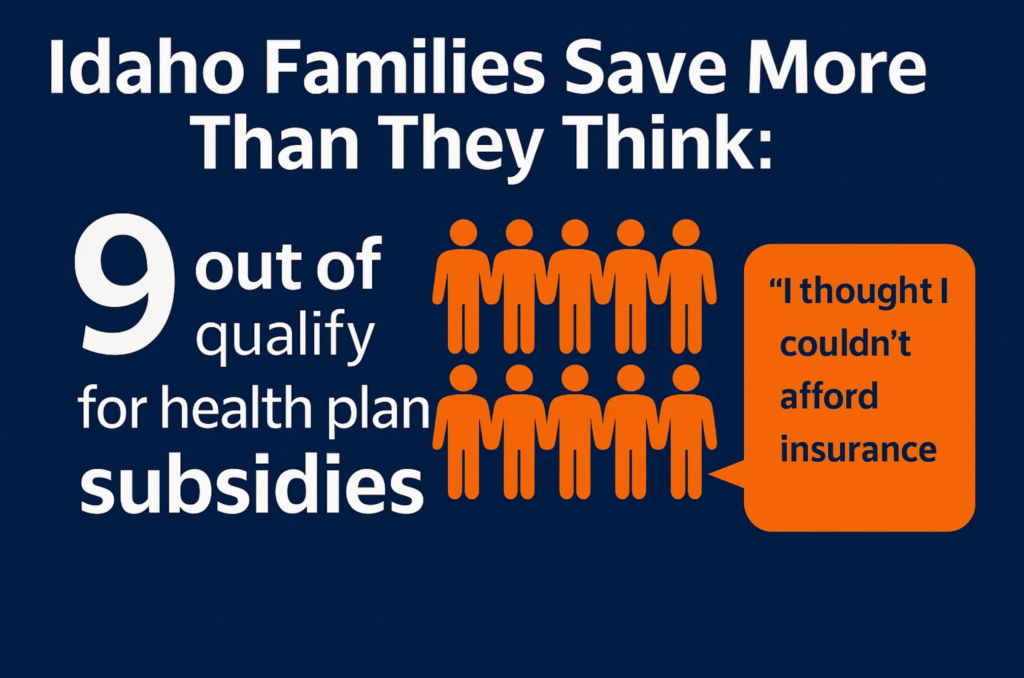
For families moving from employer-sponsored insurance to individual health insurance in Idaho, the sticker price of a plan may not be the amount they ultimately pay. Advance Premium Tax Credits, or APTCs, remain available in 2026 for eligible households purchasing qualified coverage through Your Health Idaho. The Idaho Department of Insurance states that these premium subsidies are available only when the health benefit plan is purchased through Your Health Idaho.
There is an important 2026 change here. The enhanced Premium Tax Credits introduced in 2021 expired at the end of 2025, while the regular ACA Advance Premium Tax Credits remain. Your Health Idaho also says that the previous cap limiting repayment of excess APTC has ended for 2026, making accurate and timely reporting of household income particularly important.
That makes Kyle’s conversation about income more significant than simply finding a cheaper premium. A family needs to understand what financial assistance it actually qualifies for and keep its Marketplace information current if income or household circumstances change.
Why This Matters Even More in Idaho’s 2026 Health Insurance Market
Idaho families shopping for individual health insurance are doing so during a year when affordability has become a bigger concern. The Idaho Department of Insurance reported that final 2026 individual-market premiums increased by an average of 10% statewide. Idaho nevertheless has a competitive individual market, with eight carriers offering Marketplace coverage in 2026.
Your Health Idaho’s February 2026 Marketplace Committee minutes provide additional context. Following the expiration of the enhanced tax credits, net premiums increased, the percentage of households paying less than $100 declined by 19 percentage points, and enrollment shifted toward Bronze plans. Those are statewide Marketplace trends rather than predictions about what any particular family will pay, but they reinforce why comparing only the headline premium can produce an incomplete decision.
| What to review after losing group coverage | Why it matters |
| Qualifying life event and coverage-end date | Determines whether a Special Enrollment Period may be available |
| Expected household income | Used in determining eligibility for Marketplace financial assistance |
| Family size and tax household | Can affect Marketplace eligibility calculations |
| Current doctors and hospitals | Networks differ among individual health plans |
| Children’s healthcare needs | Higher expected utilization can change which plan provides better value |
| Prescriptions | Formularies and pharmacy networks can differ |
| Premium, deductible and out-of-pocket exposure | A lower premium does not necessarily mean lower total healthcare spending |
| Existing coverage documents | May be needed to verify the qualifying event |
Why Proof of Lost Coverage Can Become the Bottleneck
The application itself was only part of this family’s enrollment process. Kyle explains that they reached a point where documentation was needed to establish the loss of coverage. The family gathered the documents, sent them to him, and he uploaded them so the eligibility process could continue.
Your Health Idaho confirms that documentation requirements vary according to the qualifying event and advises consumers to contact the Marketplace when they need guidance about the verification documents required for their situation. Federal Marketplace guidance similarly states that when someone must verify a loss of coverage, documentation should show the coverage that was lost and the date it ended.
In this particular case, Kyle says he submitted a letter from the employer describing the loss of coverage and the people covered under the plan, along with the family’s health insurance card. Those documents worked for this client’s circumstances. They should not be treated as a universal checklist for every Your Health Idaho application because verification requirements can differ.
VIDEO PART 2: From Verification to Choosing the Family’s Plans
Part 2 is where this case becomes particularly useful for families comparing health insurance in Idaho. Once the Special Enrollment Period was established, Kyle did not simply choose one plan based on the premium and put all five family members on it.
The family had specific healthcare needs involving the children and needed access to particular hospitals. Kyle says they reviewed those requirements before selecting coverage. Ultimately, the children were enrolled in a Gold plan while the parents went into a Bronze plan.
Can Parents and Children Have Different Health Insurance Plans Through Your Health Idaho?
This is one of the most useful questions raised by Kyle’s case because many families may assume everyone has to be placed on one policy.
Your Health Idaho’s materials confirm that household members can, in appropriate circumstances, be enrolled in separate health insurance plans. Its current consumer guidance explains that a separate Form 1095-A is generated for each household member enrolled in a different health plan. Your Health Idaho policy materials also recognize custom grouping, previously referred to as a “split household,” under qualified circumstances.
That does not mean splitting a family between plans is automatically better. It introduces additional issues to evaluate, and eligibility, tax-credit allocation, carrier rules and household circumstances matter. But Kyle’s case demonstrates why a family health insurance review can go further than asking, “Which family plan has the lowest premium?”
| One family plan may make sense when… | Separate plans may be worth investigating when… |
| Family members have similar provider needs | A child needs access to particular doctors or hospitals |
| The same network works well for everyone | Different household members need different networks |
| Expected healthcare use is relatively similar | Some members expect substantially greater healthcare use |
| One plan provides an acceptable cost structure for the household | Different metal levels may better fit different healthcare needs |
| Simplicity is a major priority | The potential coverage advantages justify added complexity |
The correct answer depends on the plans actually available to that household, the family members involved, eligibility rules, provider networks, expected healthcare use and total costs.
Bronze vs. Gold: Why the Cheapest Premium Isn’t Automatically the Best Family Plan
ACA Marketplace metal categories describe how a plan and its members generally divide covered healthcare costs; they do not describe the quality of medical care. A Bronze plan generally places a larger share of covered costs on the enrollee than a Gold plan, while Gold plans generally have higher premiums and lower enrollee cost sharing. Actual deductibles, copays, coinsurance, networks, drug coverage and out-of-pocket limits vary by plan.
This helps explain the strategy Kyle describes. The parents and children did not necessarily have identical healthcare needs. If the children were expected to use more covered healthcare and required particular providers, evaluating a richer plan for them could be reasonable while the parents evaluated a different cost structure for themselves. That was a decision made for this particular family after reviewing its needs, not a general recommendation that Idaho parents should put children on Gold and adults on Bronze.
For families searching “What is the best health insurance plan for a family in Idaho?”, there therefore isn’t one metal tier or carrier that can accurately answer the question for everyone. The better comparison includes the premium after any applicable tax credit, deductible, copays or coinsurance, out-of-pocket maximum, provider network, prescription formulary and the healthcare each family member expects to use.
What If My Child Needs a Specific Hospital or Specialist?
This may be the most important part of the entire case.
Health insurance is useful only within the actual terms of the plan. A family dealing with ongoing pediatric care, a particular specialist, a health system it wants to continue using, or a specific prescription should investigate those requirements before enrollment rather than discovering a network or formulary problem afterward.
Your Health Idaho provides plan-comparison tools, but families should also verify important provider participation and drug coverage using current information from the carrier and, where appropriate, the provider. Networks can vary between plans offered by the same insurer, and provider participation can change.
In Kyle’s case, the healthcare needs of the children materially affected the plan decision. That is exactly how an insurance advisor can add value: taking a broad search for “health insurance near me” and turning it into a much more precise question about what the family’s coverage actually needs to accomplish.
What Does an Insurance Agent Actually Do During a Special Enrollment Period?
This case also answers another common search question: Do I need an insurance agent to enroll through Your Health Idaho?
Consumers can apply themselves, but Your Health Idaho also provides access to certified agents and brokers at no cost to consumers for enrollment assistance. Importantly, Your Health Idaho states that licensed, YHI-certified agents and brokers can make specific recommendations about which plan to purchase, while enrollment counselors can explain available options but cannot make specific plan recommendations.
For Eagle Cap Insurance, the work in a situation like this can include helping identify the qualifying event, organizing the Marketplace application, discussing household income and possible tax-credit eligibility, helping gather required verification, comparing available plans, examining provider and hospital access, and working through how different coverage structures may affect individual family members.
Kyle’s example also shows that this assistance does not necessarily require an office visit. He says the entire case was handled by phone. For families in Idaho Falls, Ammon, Preston and elsewhere in Idaho, that can make a complicated coverage transition easier to manage when an employer plan is ending and the next effective date is approaching.
What Should You Do When Employer Health Insurance Ends?
Start with the date your coverage ends and don’t wait until the enrollment window is almost over. Determine whether the loss qualifies you for a Special Enrollment Period, gather proof of the previous coverage and its termination, and prepare current household and income information. Your Health Idaho lists Social Security numbers, employer and income information, current insurance information, previous tax returns and citizenship or immigration documentation among the information consumers may need when applying.
Then move beyond premiums. List the doctors, specialists, hospitals and prescriptions that matter to each family member. Compare the available plans against those needs and look at the deductible, cost-sharing and out-of-pocket exposure as well as the monthly premium. If some family members have significantly different healthcare needs, ask whether different plan arrangements are available and appropriate rather than assuming the entire household has to make the same choice.
The Bigger Lesson From This Idaho Family’s Enrollment
What makes this case valuable isn’t that Eagle Cap found a Bronze plan or a Gold plan. It’s that the family’s situation was treated as a family coverage problem rather than a product-selection problem.
They had lost group coverage outside Open Enrollment. Their qualifying event needed to be established. Their income and household information affected the financial-assistance conversation. Documentation had to be supplied. The family had a short practical timeline before the next month, and some of the children had specific healthcare and hospital needs. Those pieces ultimately shaped the coverage strategy.
That level of comparison matters even more in 2026. Idaho’s individual market remains competitive, but average individual premiums rose 10% for 2026 and the enhanced federal premium tax credits expired after 2025. Regular ACA premium tax credits remain available to eligible consumers through Your Health Idaho, making accurate eligibility and plan comparisons an important part of the process.
If your family recently lost employer health insurance, the most useful question may not be “Which health plan should I buy?”
It may be: “Given our income, family members, doctors, prescriptions and actual healthcare needs, how should we structure our coverage now?”
That is the conversation Kyle Bennett and Eagle Cap Insurance can help Idaho families work through.
Schedule a conversation with Kyle Bennett:
Book an appointment with Eagle Cap Insurance
Call Eagle Cap Insurance: 208-529-1522
Learn more about Life Insurance from Eagle Cap Insurance
Official Sources
- Your Health Idaho — Special Enrollment
- Your Health Idaho — Apply and Enroll
- Your Health Idaho — Coverage Guide
- Your Health Idaho — 2026 Federal Policy Changes
- Idaho Department of Insurance — 2026 Health Insurance Rates
- Idaho Department of Insurance — Individual Health Insurance
- HealthCare.gov — Losing Job-Based Health Coverage
- HealthCare.gov — Special Enrollment Verification Documents
Disclaimer: This article is for general educational purposes and does not provide individualized insurance, tax, financial, legal, or medical advice. Special Enrollment Period eligibility, documentation requirements, premium tax credits, plan availability, provider networks, formularies, effective dates and costs depend on the household, qualifying event, applicable law and plans available at the time of enrollment. The family example is based on Kyle Bennett’s account of a client experience and should not be interpreted as a recommendation that other families use the same plan or metal-tier arrangement.