





Working as a 1099 contractor gives you control over how, where, and when you work.
That flexibility can also mean taking responsibility for protections that a traditional employer might otherwise help provide. An independent contractor may need to arrange personal health coverage, life insurance, disability income protection, retirement savings, and other benefits independently.
The IRS generally considers independent contractors and people operating their own businesses to be self-employed. Payments for nonemployee services are commonly reported on Form 1099-NEC rather than Form W-2. (IRS: Independent Contractor Defined)
That creates an important question for Idaho consultants, remote contractors, tradespeople, freelancers, founders, and solo business owners:
If your income depends on your ability to work, what protects your household when you cannot?
Commercial coverage may protect the business. Homeowners or renters insurance may protect personal property. Health insurance may help pay for covered medical care. However, those policies do not automatically replace the owner’s income or provide a death benefit for the family.
That is why life insurance and disability insurance are often among the first personal protection areas worth reviewing.
The First Coverage Gap Kyle Looks for
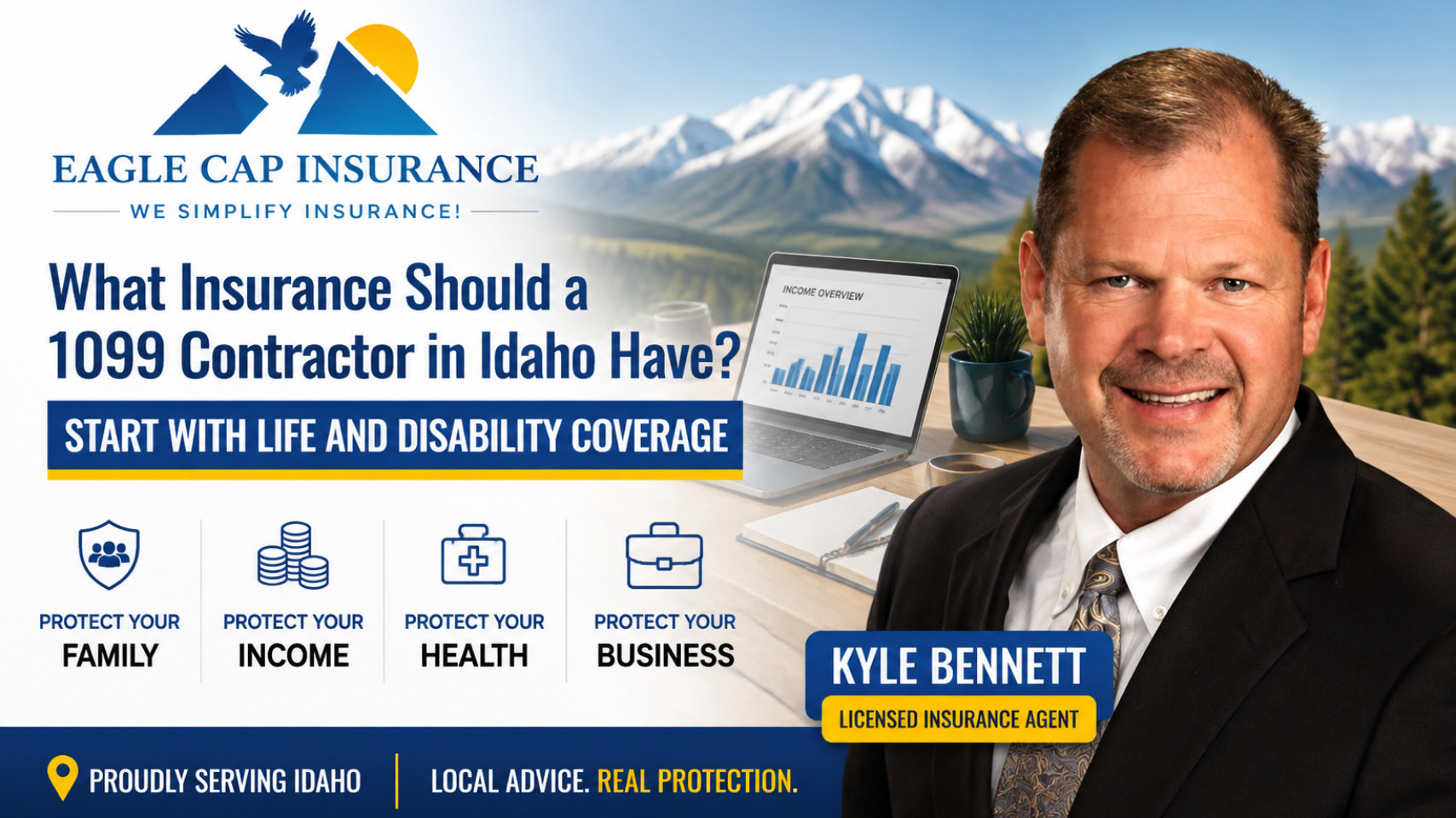
In the video below, Kyle Bennett of Eagle Cap Insurance responds to a practical question:
When a 1099 contractor or self-employed person has no traditional employer safety net, which coverage gap should be reviewed first?
Kyle explains that he begins with a conversation about the client’s financial responsibilities. He looks at whether the person’s life insurance reflects the income and economic value their household depends on. He then reviews disability insurance because an illness or injury could prevent the person from producing that income.
Watch Kyle Explain the First Two Coverage Priorities
Kyle uses an example of a business owner earning $100,000 and discusses evaluating a possible life insurance amount based on a multiple of earnings. That figure is an illustration from the conversation, not a universal coverage formula.
The appropriate amount of life insurance depends on the individual’s debts, income, dependents, existing assets, business obligations, budget, policy eligibility, and long-term goals.
Business Insurance Protects the Company. Personal Insurance Protects the Person Behind It.
A self-employed person may have commercial policies in place and still have a serious personal protection gap.
General liability insurance can respond to certain third-party injury or property-damage claims, subject to the policy. Commercial property insurance may protect covered business equipment or inventory. Professional liability may address certain claims arising from professional services.
Those policies generally serve different purposes from personal life and disability insurance.
| Coverage | Primary function | Question it helps answer |
| Commercial insurance | Protects certain business property, operations, vehicles, or liability exposures | What happens if the company faces a covered loss or claim? |
| Health insurance | Helps pay for covered health care under the plan’s terms | How will covered medical care be paid for? |
| Life insurance | Pays a stated death benefit to beneficiaries when policy requirements are met | What financial resources would my family or business have if I died? |
| Disability insurance | May replace part of eligible income when a covered disability prevents work | How would I continue paying expenses if I could not earn income? |
This distinction is especially important for remote consultants and independent contractors whose business has few physical assets.
In many cases, the person’s ability to deliver the work is the business’s most valuable income-producing asset.
Why Life Insurance Comes Into the Conversation
Life insurance is designed to provide a death benefit to the policy’s beneficiaries, subject to its terms.
The Idaho Department of Insurance explains that term life insurance provides coverage for a specified term. If the insured dies during that term while the policy is in force, the policy pays the stated death benefit. Permanent policies work differently and may remain in force for life when policy requirements are met. (Idaho Department of Insurance: Life Insurance)
For a self-employed person, the life insurance conversation may include:
- Income a spouse or children rely on
- Mortgage, rent, or other debts
- Childcare and household expenses
- Future education needs
- Final expenses
- Business loans or guarantees
- A partner’s ability to continue the company
- Existing savings, investments, and insurance
- How many years the income may need to be replaced
Is a Multiple of Income Enough?
Income multiples can offer a starting point, but they do not replace a personal needs analysis.
Kyle’s video uses an example of up to 20 times annual earnings. Actual eligibility and suitable coverage may differ significantly. Insurers consider factors such as age, health, occupation, finances, requested death benefit, and underwriting requirements.
A more complete review asks what the money would need to accomplish.
| Factor to calculate | Example questions |
| Income replacement | How much household income would disappear, and for how many years? |
| Debts and obligations | Is there a mortgage, business debt, or personally guaranteed loan? |
| Dependents | Who relies financially on the contractor or owner? |
| Existing resources | What savings, investments, and existing life insurance are already available? |
| Business responsibilities | Would money be needed to replace the owner, repay debt, or support a transition? |
| Affordability | What premium can the person maintain without straining cash flow? |
The objective is not to reach the largest number possible. It is to identify a defensible amount that fits the client’s responsibilities and budget.
Why Disability Insurance May Be Just as Important
Life insurance addresses death. Disability insurance addresses a different risk: remaining alive but losing the ability to earn income because of a covered illness or injury.
The Social Security Administration states that studies show a 20-year-old worker has approximately a one-in-four chance of developing a disability before reaching full retirement age.
Social Security Disability Insurance may provide monthly benefits to eligible people with sufficient work history who meet the federal definition of disability. However, eligibility is not automatic, and private disability policies can serve a different role by insuring a portion of earned income under their own definitions and contract terms. (Social Security Administration: Disability)
For a 1099 contractor, losing the ability to work may affect both sides of the household finances:
- Income stops or declines.
- Business and personal expenses may continue.
Rent, mortgage payments, groceries, utilities, insurance premiums, business software, equipment financing, and taxes do not disappear simply because the owner is unable to work.
Why Tax Returns Matter When Applying for Disability Coverage
Kyle explains that he may review the previous two years of tax returns when discussing disability coverage with a self-employed client.
That is relevant because disability insurers generally need documented earnings to determine how much income can be insured. For self-employed applicants, gross business revenue is not necessarily the same as personal earned income.
Tax returns may help establish:
- Net self-employment income
- Income consistency
- Business structure
- Owner compensation
- Other income sources
- A reasonable benefit amount
An insurer may request different documentation depending on the policy, carrier, occupation, and financial circumstances.
Kyle also mentions a future increase option or rider. Depending on the policy, this type of feature may allow the insured to apply for additional coverage later without repeating certain medical underwriting requirements, although financial documentation, limits, timing rules, and additional premiums may still apply.
Riders vary by insurer and are not available on every policy.
Where Eagle Cap Insurance Helps
Life and disability coverage can be difficult to compare because the decision involves more than premiums.
Eagle Cap Insurance helps Idaho contractors and business owners turn a broad concern into a structured review.
That may include:
- Identifying who depends on the client’s income
- Reviewing existing personal and employer-connected coverage
- Separating commercial insurance from personal income protection
- Estimating life insurance needs based on actual obligations
- Reviewing income documentation for disability coverage
- Comparing benefit periods and waiting periods
- Explaining policy definitions, limitations, exclusions, and riders
- Discussing how future income growth could affect coverage
- Coordinating questions that should be taken to a tax or legal professional
- Revisiting coverage as income, family needs, or the business changes
Eagle Cap’s role is not to assume every contractor needs the same policy.
It is to help the client answer a more useful question:
What financial responsibility remains if I die or lose the ability to work?
A Simple Coverage Checkup for Idaho Contractors
Before meeting with an advisor, gather:
- Two recent personal and business tax returns
- Current life and disability policy statements
- Monthly household expenses
- Mortgage and debt balances
- Business loans or personal guarantees
- A list of financial dependents
- Savings and emergency reserves
- Expected income growth
- Any coverage connected to a spouse’s employer
- The amount of income the household could not afford to lose
Then ask:
- How long could my household operate without my income?
- Is my current life insurance enough to meet the obligations I would leave behind?
- Would my commercial policies replace my personal income? Usually, they serve a different purpose.
- How does the disability policy define disability?
- What percentage or amount of documented income may be insured?
- How long is the waiting period before benefits may begin?
- How long could benefits continue?
- Can coverage increase as my income grows?
- Which exclusions and limitations apply?
Final Takeaway
A 1099 contractor may have a successful business, responsible commercial coverage, and strong revenue while still carrying a major personal insurance gap.
The business may be insured.
The person producing its income may not be.
Life insurance can help create financial resources for beneficiaries after death. Disability insurance may help replace part of eligible income when a covered illness or injury prevents work. They perform different functions, and both deserve attention when a household or business depends heavily on one person’s earnings.
Eagle Cap Insurance helps contractors, remote professionals, self-employed workers, and business owners across Idaho review those risks in plain English and compare coverage based on documented income, real obligations, and long-term goals.
Schedule a conversation with Kyle Bennett
Call Eagle Cap Insurance:
208-529-1522
Learn more about life insurance
Learn more about disability insurance
Disclaimer: This article is for general educational purposes and does not provide individualized insurance, legal, tax, or financial advice. Coverage availability, underwriting, benefit amounts, riders, definitions, exclusions, premiums, and eligibility vary by insurer and applicant. Any income multiple discussed in the video is an example, not a universal recommendation or guarantee.