




If your paycheck stopped tomorrow, how long could your household continue paying the bills?
It’s not a question most people ask themselves until life forces them to.
A serious illness. An unexpected injury. A surgery with a long recovery. A chronic health condition that keeps you from working.
While most people insure their home, car, and health, many never stop to think about the one asset that pays for all of those things: Their income.
For many Idaho families, losing an income for even a few months can create financial pressure long before long-term disability or retirement planning ever becomes a concern.
If you’ve searched questions like:
- What happens if I can’t work because of an illness?
- How long can I survive without a paycheck?
- Do I need disability insurance if I have savings?
- How much emergency savings should I have?
- What happens if my income suddenly stops?
This article answers those questions—and explains why income protection should be part of every financial plan.
Kyle Bennett’s Perspective: What Really Happens During the First 90 Days?
In the video below, Kyle Bennett of Eagle Cap Insurance walks through a realistic scenario.
He asks people to imagine one simple event: Your paycheck disappears tomorrow.
Not because you quit. Not because you retired.
Because you physically cannot work.
Rather than jumping straight into insurance terminology, Kyle walks through what actually happens in real life.
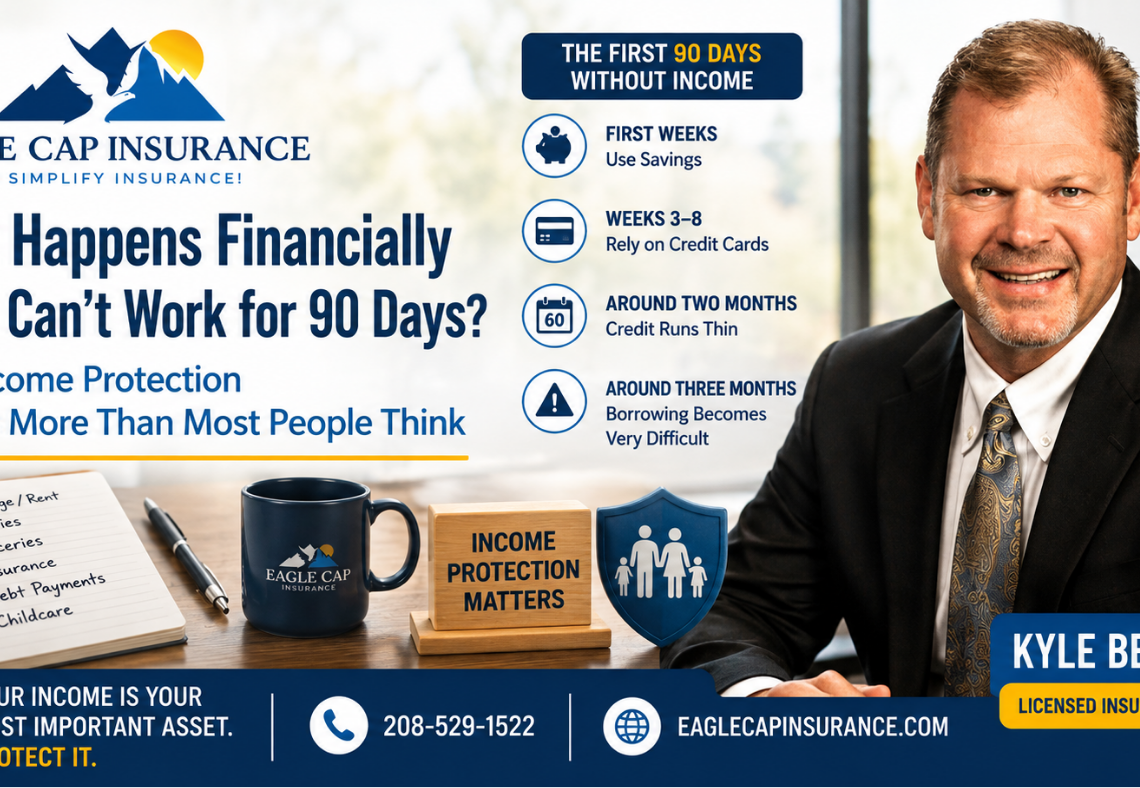
First, people use savings. Then, if savings aren’t enough, they often rely on credit cards.
If credit is exhausted, many begin looking for loans—but as Kyle points out, borrowing money becomes much harder once your income has stopped.
His message isn’t designed to create fear.
It’s designed to help people understand how quickly income loss becomes a financial problem.
▶ Watch Kyle explain why the first 90 days matter.
The First Financial Question Isn’t “How Sick Am I?”
It’s: “How long can I pay my bills without a paycheck?”
Many people assume they’ll “figure it out.”
But household expenses don’t usually pause because someone becomes sick or injured.
Monthly obligations often continue, including:
- Mortgage or rent
- Utilities
- Groceries
- Fuel
- Childcare
- Car payments
- Insurance premiums
- Student loans
- Internet and phone service
- Business expenses (if self-employed)
Health insurance may help pay for covered medical care.
It generally does not replace lost income.
That’s an entirely different financial problem.
Why Income Protection Matters More Than Most People Realize
For many households, income is the engine that keeps everything else running.
The Social Security Administration reports that today’s 20-year-old worker has about a 1 in 4 chance of experiencing a disability before reaching full retirement age.
That statistic isn’t meant to suggest everyone will experience a disability.
It simply explains why financial planners often view income as one of the most valuable assets someone owns.
When income stops unexpectedly, financial decisions become much harder.
A Realistic Look at the First 90 Days
Kyle’s example closely mirrors how many households manage financial emergencies.
While every situation is different, the sequence often looks something like this:
| Time Without Income | What Many Households Turn To |
| First few weeks | Checking account and emergency savings |
| Weeks 3–8 | Remaining savings and available cash |
| Around two months | Credit cards or personal lines of credit |
| Around three months | Borrowing becomes more difficult, debt increases, financial pressure grows |
The exact timeline varies depending on:
- Savings
- Household expenses
- Existing debt
- Other income sources
- Insurance coverage
- Family support
But one thing usually remains true: Bills continue arriving.
Do Most Americans Have Enough Emergency Savings?
Financial experts generally recommend maintaining an emergency fund covering several months of living expenses.
Consumer guidance from organizations like the Consumer Financial Protection Bureau encourages households to build emergency savings to prepare for unexpected events.
Many households, however, continue to report financial vulnerability.
According to the Federal Reserve’s Report on the Economic Well-Being of U.S. Households, many adults would experience difficulty covering unexpected expenses without borrowing or selling something.
Savings are incredibly valuable.
But savings alone aren’t always enough if someone cannot work for several months—or longer.
What Happens After Savings Run Out?
This is the part of Kyle’s discussion that resonates with many people.
Once savings are depleted, households often begin relying on:
- Credit cards
- Personal loans
- Home equity (if available)
- Family assistance
- Retirement withdrawals
Each option carries tradeoffs.
- Credit cards may have high interest rates.
- Retirement withdrawals may affect long-term savings.
- Loans usually require repayment.
- Borrowing becomes more difficult if income has stopped.
Kyle summarizes it simply: People often discover that borrowing money is easiest before they need it—not after.
Where Disability Insurance Fits Into This Picture
This is where disability insurance serves a different purpose than health insurance.
Health insurance helps pay for covered medical care.
Disability insurance is designed to help replace a portion of income if a covered illness or injury prevents someone from working, according to the policy’s terms and conditions.
Those are two different financial risks.
| Health Insurance | Disability Insurance |
| Helps pay covered medical expenses | May replace a portion of eligible income |
| Focuses on healthcare costs | Focuses on household cash flow |
| Pays healthcare providers | Helps the insured continue paying everyday living expenses |
| Doesn’t generally replace lost wages | Designed specifically for income replacement |
Understanding that distinction is one of the most important financial conversations someone can have.
Who Should Think About Disability Insurance?
Many people assume disability insurance is only for physically demanding jobs.
In reality, income protection can matter for anyone whose household depends on earned income.
Including:
- Office professionals
- Remote workers
- Healthcare workers
- Teachers
- Sales professionals
- Engineers
- Tradespeople
- Small business owners
- Self-employed professionals
- Consultants
- Technology workers
The question isn’t necessarily: “Is my job dangerous?”
It’s: “What happens financially if I can’t perform my job?”
Questions People Frequently Ask Before Buying Disability Insurance
Many Idaho families begin by asking practical questions.
How much income does disability insurance replace?
Benefit amounts vary by insurer and policy.
Many policies replace only a portion of pre-disability earnings, subject to underwriting and policy limits.
Does disability insurance cover every illness or injury?
No. Coverage depends on the specific contract.
Policies include definitions, exclusions, waiting periods, and benefit limitations.
How long do benefits last?
Benefit periods differ. Some policies provide benefits for several years.
Others may continue to retirement age, depending on the policy purchased.
Do I still need disability insurance if I have emergency savings?
Savings and disability insurance serve different purposes.
Emergency savings may help cover short-term unexpected expenses.
Disability insurance may help provide ongoing income replacement during a covered disability.
Many financial plans use both.
What if I already have disability coverage through work?
Employer-sponsored disability coverage can be valuable.
However, benefit percentages, taxation, portability, and policy terms vary.
Reviewing employer coverage helps determine whether it aligns with your financial needs.
Where Eagle Cap Insurance Helps
One of the biggest mistakes people make isn’t buying the wrong disability policy.
It’s never reviewing their options at all.
At Eagle Cap Insurance, Kyle Bennett helps individuals, families, business owners, and self-employed professionals understand:
- How employer disability benefits work
- Individual disability insurance options
- Income replacement strategies
- Waiting periods
- Benefit periods
- Policy riders
- Tax considerations
- How disability insurance fits alongside life insurance and health insurance
- How much protection may make sense based on income and household obligations
Rather than recommending the same policy for everyone, the conversation starts with one question: “If your income stopped tomorrow, what would happen next?”
That answer looks different for every household.
A Simple Income Protection Checkup
Before meeting with an insurance advisor, gather the following information.
| Information to Review | Why It Matters |
| Monthly household expenses | Determines how much income is needed each month |
| Emergency savings | Shows how long existing reserves might last |
| Employer disability benefits | Helps identify existing protection |
| Existing disability policies | Avoids duplicate or overlapping coverage |
| Mortgage and debt | Identifies ongoing financial obligations |
| Family income sources | Determines how dependent the household is on one paycheck |
| Self-employment income | Important when evaluating disability coverage for business owners |
| Life insurance | Ensures overall protection strategy works together |
This simple review often reveals whether current protection aligns with the household’s financial reality.
Common Income Protection Mistakes
People often assume:
- Health insurance replaces lost income.
- Savings alone will cover several months without work.
- Disability only happens because of workplace accidents.
- Employer disability coverage automatically replaces full income.
- Disability insurance is something to buy later.
Many discover those assumptions only after income has already stopped.
Planning before that happens creates more options.
Final Takeaway
Unexpected illnesses and injuries don’t just create medical challenges.
They create income challenges.
For many Idaho households, the first 90 days without a paycheck can become a financial turning point if there isn’t a plan in place.
Emergency savings can help. Responsible budgeting helps.
But when income stops for an extended period, disability insurance may become one of the most valuable protections a household has.
At Eagle Cap Insurance, Kyle Bennett helps individuals, families, business owners, and self-employed professionals understand how disability insurance fits into a complete financial protection strategy—not through fear, but through education and thoughtful planning.
Because the most important financial question isn’t whether something unexpected could happen.
It’s whether your household would be prepared if it did.
Schedule a conversation with Kyle Bennett
Call Eagle Cap Insurance
208-529-1522
Learn more about Disability Insurance
Sources
- Social Security Administration – Disability Statistics
- Consumer Financial Protection Bureau – Emergency Savings Guide
- Federal Reserve – Report on the Economic Well-Being of U.S. Households
- Idaho Department of Insurance – Disability Insurance Consumer Information
Disclaimer: This article is for educational purposes only and should not be considered legal, financial, tax, or insurance advice. Disability insurance policies vary by insurer and include specific eligibility requirements, waiting periods, benefit periods, exclusions, definitions, and limitations. Consult a licensed insurance professional to discuss your individual circumstances before making coverage decisions.