








Losing employer-sponsored health insurance can create immediate pressure.
Maybe you were laid off. Maybe you left a job voluntarily. Maybe your hours were reduced. Maybe your spouse carried the family health plan and that coverage is ending.
Then a COBRA election notice arrives.
The instinct is understandable: “I need health insurance. I should probably just sign this.”
But before automatically electing COBRA, Idaho families may have other coverage options worth comparing.
COBRA can be the right answer. It can let eligible workers and family members temporarily continue the same employer-sponsored group health coverage after certain qualifying events. But COBRA can also mean paying the full premium yourself, including the portion the employer previously paid, plus an administrative charge. The U.S. Department of Labor says qualified beneficiaries may generally be charged up to 102% of the plan’s total cost. (U.S. Department of Labor)
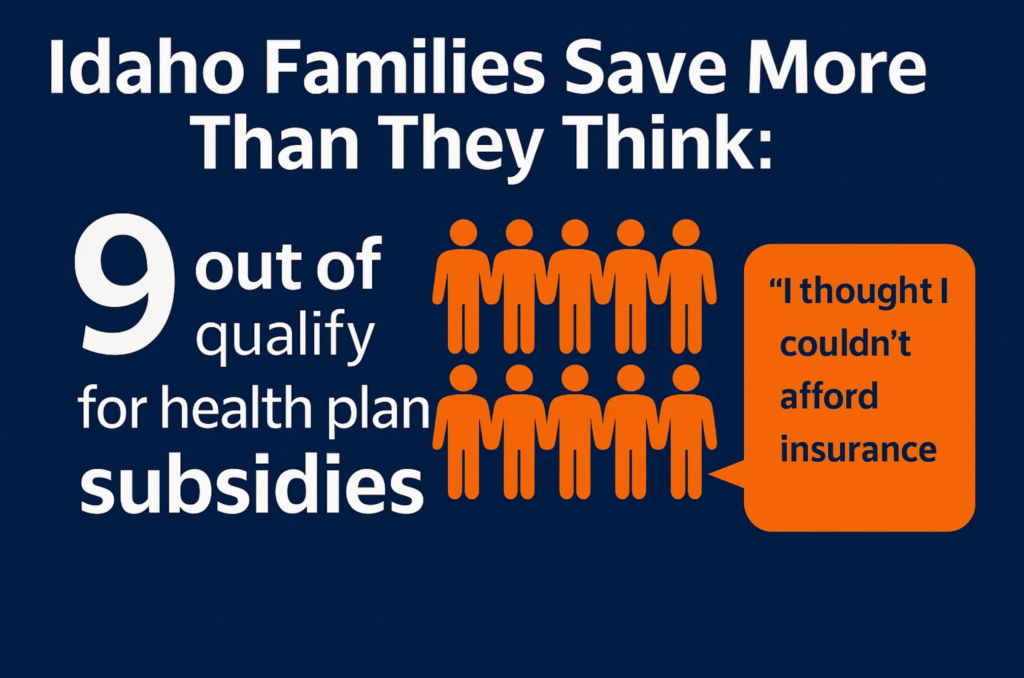
Meanwhile, losing employer coverage may open a Special Enrollment Period through Your Health Idaho, giving an individual or family a chance to compare Marketplace coverage and determine whether they qualify for premium tax credits or additional cost-sharing assistance. (Your Health Idaho)
That is why this transition deserves a conversation before a rushed decision.
Kyle Bennett’s Advice: Compare Your Options Before You Lock Into One
In the video below, Kyle Bennett of Eagle Cap Insurance talks about a mistake he frequently sees when people lose employer-sponsored health insurance: making a COBRA decision before understanding what other coverage may be available.
Kyle’s point is simple.
COBRA should be compared, not automatically accepted or automatically rejected.
A family may ultimately determine that COBRA is the best fit. Another household may find that a plan through Your Health Idaho better fits its income, doctors, prescriptions, or budget.
The important part is doing that comparison while the relevant enrollment windows are still open.
One clarification is important because enrollment rules matter: federal COBRA rules generally provide a 60-day election period, beginning from the later of when job-based coverage ends or when the COBRA election notice is provided. The Department of Labor also says that after electing COBRA, an individual generally has 45 days to make the first premium payment. (U.S. Department of Labor)
So while the video discusses waiting before electing COBRA and retroactive coverage, consumers should rely on the dates in their actual COBRA election notice rather than assuming they have three months.
What Does COBRA Actually Do?
COBRA stands for the Consolidated Omnibus Budget Reconciliation Act.
For qualifying employer health plans, COBRA gives certain employees, spouses, former spouses, and dependent children the right to temporarily continue group health coverage after qualifying events such as job loss or reduced work hours. (U.S. Department of Labor)
One of COBRA’s biggest advantages is continuity.
The Department of Labor notes that COBRA typically allows someone to keep the same health benefits they had while employed, including access to the same coverage structure and doctors, subject to the plan’s terms. (U.S. Department of Labor)
That can be especially valuable if someone:
- Is currently undergoing treatment
- Has already satisfied much of the plan-year deductible
- Wants to keep an established provider network
- Has upcoming procedures
- Needs continuity for family members
- Is between jobs for a relatively short period
But continuity comes with a cost.
When employed, the company may have paid a significant share of the premium. Under COBRA, the former employee usually becomes responsible for the entire cost.
That is why “keeping the same plan” and “keeping the same price” are two very different things.
COBRA vs. Your Health Idaho After Losing Employer Coverage
Losing job-based coverage is a qualifying life event that may allow an Idaho resident to enroll through Your Health Idaho outside the normal Open Enrollment period.
Your Health Idaho says someone who recently lost or expects to lose employer-sponsored health coverage may qualify for a Special Enrollment Period and potentially for a tax credit. (Your Health Idaho)
Here is the basic comparison:
| COBRA Continuation Coverage | Your Health Idaho Special Enrollment |
| Continues the employer-sponsored plan, subject to COBRA eligibility | Allows eligible Idaho residents to shop for individual Marketplace coverage |
| Usually preserves the existing plan and provider network | Provider networks and plan benefits may differ |
| Individual generally pays the full group premium plus permitted administrative cost | Premium tax credits may reduce monthly premiums for eligible households |
| Usually must be elected within a 60-day COBRA election period | Loss of employer coverage generally creates a 60-day Special Enrollment window |
| May include medical, dental, and vision continuation if those benefits qualify under the group plan | Medical plans are compared through Your Health Idaho; other coverage may need separate review |
| Useful when continuity of existing coverage is especially important | Useful when a household wants to compare different plans, costs, and financial assistance |
Sources: U.S. Department of Labor and Your Health Idaho. (U.S. Department of Labor)
Neither option automatically wins.
The right comparison depends on the household.
Can You Choose a Marketplace Plan Instead of COBRA?
Yes, depending on timing and eligibility.
HealthCare.gov says people who lose job-based insurance can generally enroll in a Marketplace plan within 60 days of losing that coverage, and they can compare Marketplace plans and prices with their COBRA offer. (HealthCare.gov)
The Department of Labor similarly states that people may apply for Marketplace coverage even if they are eligible for COBRA. (U.S. Department of Labor)
This is where timing becomes critical.
If you elect COBRA and are still within the 60-day Special Enrollment window triggered by the loss of employer coverage, HealthCare.gov says you may still switch to Marketplace coverage. After that initial window closes, voluntarily dropping COBRA generally does not create a new Special Enrollment Period. You would typically need another qualifying life event, COBRA exhaustion, the loss of an employer COBRA contribution in applicable circumstances, or Open Enrollment. (HealthCare.gov)
That is more accurate than saying that electing COBRA immediately means you are always “stuck” until Open Enrollment.
The real issue is that waiting too long can close other enrollment windows.
That is why reviewing options quickly matters.
What About COBRA Being Retroactive?
COBRA has an unusual feature that can make it useful during a coverage transition.
The U.S. Department of Labor says a plan must generally give qualified beneficiaries at least 60 days to elect COBRA. Depending on plan rules, COBRA coverage may begin from the date it is elected or may be retroactive to the date the prior coverage was lost.
The Department also explains that after someone elects COBRA, the initial premium payment generally may be made within 45 days.
This can create breathing room, but it should not be treated casually.
If you are considering waiting to elect COBRA:
- Read the election notice carefully.
- Confirm the exact deadline.
- Understand how retroactive coverage works under your plan.
- Know how much premium would become due.
- Compare alternatives before the Marketplace Special Enrollment window closes.
COBRA rules are deadline-driven. Missing the deadline can eliminate the option.
Could Your Family Qualify for a Premium Tax Credit?
This is one of the biggest reasons to compare coverage before making a decision.
Your Health Idaho allows eligible households to apply for Advance Premium Tax Credits, which reduce the monthly cost of qualified health coverage. Eligibility depends on household circumstances, income, and current federal rules.
Your Health Idaho also provides an online estimator that can show estimated tax credits and Cost-Sharing Reductions after entering household information.
For someone who recently lost a job, income may be very different from when they were employed.
That matters because Marketplace financial assistance is based in part on projected household income for the coverage year.
An insurance advisor can help organize the information needed to compare:
- Household size
- Estimated annual income
- Spouse income
- Dependents needing coverage
- Current doctors
- Prescriptions
- Expected medical use
- Available Marketplace plans
- COBRA premium
- Deductibles and out-of-pocket exposure
Instead of asking only, “What is the monthly premium?”, the better question is:
“What is likely to be the best overall coverage and cost structure for my family?”
What Are Cost-Sharing Reductions?
Some households that qualify for Marketplace assistance may also qualify for Cost-Sharing Reductions, or CSR.
CSR does not lower the premium itself. It reduces certain out-of-pocket expenses such as deductibles, copayments, and coinsurance.
Your Health Idaho states that Cost-Sharing Reductions are available to eligible consumers enrolled in a Silver-tier plan. (Help Center)
That means someone comparing COBRA against a Marketplace plan should not compare premiums alone.
Consider this hypothetical structure:
| Question | Why It Matters |
| What is the COBRA monthly premium? | You may now be paying both your previous employee share and the employer share |
| What Marketplace tax credit might apply? | It may reduce the monthly premium if you qualify |
| Could the household qualify for CSR? | Eligible Silver plans may reduce deductibles, copays, and coinsurance |
| Are current doctors in network? | Lower premiums may not help if important providers are unavailable |
| How are prescriptions covered? | Formularies and pharmacy networks can materially affect costs |
| How much of the current deductible has already been met? | Starting a new plan may reset deductible accumulation |
| How long is the coverage needed? | A short bridge and a longer transition may lead to different decisions |
This is exactly where personalized health plan assistance becomes useful.
What About Dental and Vision COBRA?
Dental and vision coverage should also be reviewed separately rather than automatically accepted or dropped.
The U.S. Department of Labor confirms that COBRA may apply to group health benefits including dental and vision care.
Kyle mentions in the video that, in his experience, dental and vision COBRA may sometimes be worth keeping.
That should be treated as an advisor’s practical observation rather than a universal price rule.
Whether COBRA dental or vision is cheaper than buying separate coverage depends on the employer plan, COBRA premium, available individual options, provider networks, benefit limits, and household needs.
Compare the actual numbers.
Where Eagle Cap Insurance Comes In
The value of an insurance advisor during job loss is not simply filling out an application.
It is helping a family understand how the choices interact before deadlines disappear.
Eagle Cap Insurance can help Idaho individuals and families review:
- COBRA continuation coverage
- Loss-of-coverage Special Enrollment eligibility
- Your Health Idaho options
- Household income information
- Potential premium tax credit eligibility
- Cost-Sharing Reduction eligibility
- Silver, Bronze, and other available plan structures
- Provider networks
- Prescription coverage
- Deductibles
- Out-of-pocket maximums
- Family coverage needs
- Dental and vision options
Sometimes that analysis may lead to a Marketplace plan.
Sometimes COBRA may still be the better answer.
That is an important part of Kyle’s point in the video: the purpose of the conversation is not to avoid COBRA. It is to determine whether COBRA is actually the best option after everything else has been compared.
A Better Order of Operations After Losing Health Insurance
If you have just lost employer-sponsored coverage in Idaho, consider this sequence:
- Get your COBRA election notice and identify the exact deadline.
- Do not assume COBRA is either too expensive or automatically best.
- Check whether the loss of employer coverage qualifies you for a Special Enrollment Period through Your Health Idaho.
- Estimate household income and possible Marketplace financial assistance.
- Compare doctors, prescriptions, deductibles, premiums, and out-of-pocket costs.
- Review dental and vision separately if COBRA continuation is available.
- Make the decision before the applicable enrollment windows close.
The U.S. Department of Labor specifically encourages workers to consider alternatives such as another employer plan, Marketplace coverage, Medicaid, or CHIP before deciding on COBRA.
Understanding Your Health Insurance Transition Options
Losing employer health insurance creates urgency, but urgency should not turn into an automatic decision.
COBRA can provide valuable continuity. For some families, keeping the same doctors, treatment plan, deductible progress, and benefits may make it the strongest option.
For other Idaho households, losing employer coverage may create an opportunity to enroll through Your Health Idaho and potentially receive premium tax credits or Cost-Sharing Reductions.
The important thing is to compare those options before the deadlines pass.
Eagle Cap Insurance helps Idaho individuals and families work through that comparison in plain English: COBRA cost, Your Health Idaho eligibility, household income, tax credits, cost-sharing assistance, doctors, prescriptions, deductibles, dental, vision, and the full cost of coverage.
And sometimes, after reviewing everything, the answer may still be:
COBRA makes the most sense.
The difference is that you made that decision with the full picture in front of you.
Schedule an appointment with Kyle Bennett at Eagle Cap Insurance
Call: 208-529-1522
Learn more about health insurance
Official Sources
- U.S. Department of Labor, COBRA Continuation Coverage
- U.S. Department of Labor, COBRA FAQs for Workers
- Your Health Idaho, Loss of Coverage
- Your Health Idaho, Special Enrollment
- Your Health Idaho, Health Insurance Tax Credit Estimator
- Your Health Idaho, Cost-Sharing Reductions
Disclaimer: This article is for general educational purposes only. COBRA deadlines, Marketplace eligibility, financial assistance, plan availability, costs, provider networks, benefits, and enrollment rules depend on individual circumstances and current law. Review your official COBRA election notice and applicable Your Health Idaho requirements before making coverage decisions.