




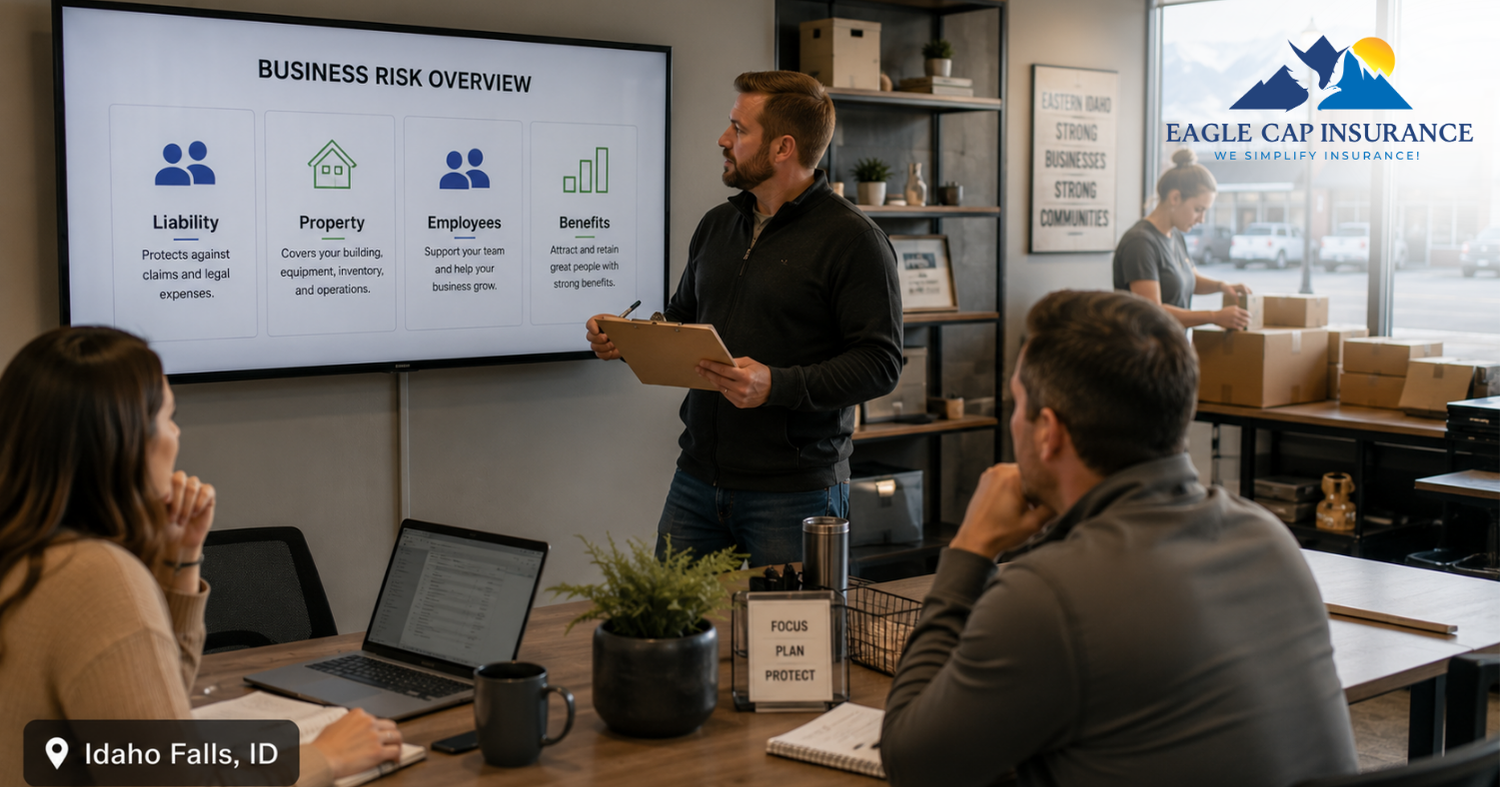
Small business owners in Idaho Falls carry a lot.
You may be managing customers, employees, equipment, vehicles, leases, payroll, contracts, vendors, and family responsibilities at the same time. Insurance is one of those things that often gets reviewed only when something forces the conversation: a lease renewal, a new employee, a client contract, a lender request, a claim, or a close call.
That is why many business owners eventually ask:
“What insurance does my small business actually need?”
The honest answer is that it depends on the business. A contractor, café owner, consultant, farm-related business, retail shop, professional office, and growing employer do not all have the same risk. But most Idaho Falls small businesses should understand a few core categories: general liability insurance, property coverage, workers’ compensation, commercial auto, business interruption, life and disability protection, and group health plan assistance.
Idaho has a strong small business economy. The U.S. Small Business Administration reported that Idaho had 207,670 small businesses, making up 99.2% of Idaho businesses, and those businesses employed 386,078 people, or 56.0% of Idaho employees, in its 2025 Idaho Small Business Profile.
That matters because business insurance is not just a large-company issue. It is a Main Street issue. It affects Idaho Falls business owners, self-employed professionals, family-run businesses, local employers, and growing companies throughout Ammon, Iona, Ucon, and Eastern Idaho.
This guide explains what small business owners should review before choosing business insurance in Idaho Falls.
Why Small Business Insurance Is Not One Single Policy
Many business owners hear “business insurance” and think it means one policy that covers everything.
That is usually not how it works.
Business insurance is often a group of coverages designed to protect different parts of the business. One policy may help with customer injury claims. Another may help with damaged equipment or business property. Another may be required if you have employees. Another may help with employee benefits or owner protection.
The goal is not to buy every possible policy. The goal is to understand where your business has real exposure.
A small business insurance review should look at:
- What the business does
- Whether customers visit your location
- Whether you work at client sites
- Whether you own or lease property
- Whether you use vehicles for business
- Whether you have employees
- Whether you hire subcontractors
- Whether contracts require certain coverage
- Whether your income depends heavily on one owner
- Whether you offer or want to offer employee benefits
- Whether your family depends on business income
For Idaho Falls business owners, the right conversation is not, “What is the cheapest business insurance?”
A better question is: “What could realistically interrupt my business, create liability, or put my income at risk?”
A Simple Business Insurance Checkup for Idaho Falls Owners
Use this table as a starting point before reviewing your coverage with a local advisor.
| Coverage Area | What It Usually Helps Protect | Questions to Ask |
| General liability insurance | Customer injury claims, property damage claims, and certain legal defense costs, depending on the policy | Do customers visit my business? Do I work on other people’s property? Do client contracts require liability coverage? |
| Commercial property insurance | Business-owned building, equipment, inventory, furniture, tools, or other property, depending on the policy | What would it cost to replace the equipment or property I need to keep operating? |
| Workers’ compensation | Employee work-related injuries or illnesses, as required under Idaho rules unless exempt | Do I have any full-time, part-time, seasonal, or occasional employees? |
| Commercial auto insurance | Vehicles used for business purposes | Do I or my employees drive for work, make deliveries, visit job sites, or transport tools or equipment? |
| Business interruption coverage | Lost business income after certain covered events, depending on the policy | If my business had to close temporarily after a covered loss, how long could I keep paying bills? |
| Group health plan assistance | Health coverage options for employees and sometimes owners, depending on business structure and eligibility | Am I trying to attract, retain, or support employees with health benefits? |
| Life and disability insurance | Owner, partner, family, income, or business continuity needs | What happens to the business or my family if I die or cannot work? |
This table is not a coverage recommendation. It is a practical checklist to help business owners know what questions to bring into the conversation.
General Liability Insurance: The Starting Point for Many Businesses
For many small businesses, general liability insurance is one of the first coverages to review.
General liability insurance may help protect a business from certain claims involving bodily injury, property damage, and related legal defense costs, depending on the policy. Idaho Business Wizard explains that business insurance policies can cover direct financial liabilities and legal defense expenses.
This matters for many Idaho Falls businesses because liability can show up in ordinary situations.
For example:
- A customer slips at your business location.
- You accidentally damage a client’s property.
- A contractor is required to show proof of insurance before starting a job.
- A landlord asks for liability coverage before signing a lease.
- A vendor or client contract requires certain insurance limits.
General liability insurance is often part of doing business professionally. It may not be the only coverage you need, but it is a common foundation.
What to Review With General Liability
Before choosing a policy, ask:
- What types of claims are covered?
- What exclusions apply?
- What coverage limits are required by contracts or landlords?
- Are subcontractors or independent contractors involved?
- Does the business work at customer locations?
- Does the business need certificates of insurance?
- Are completed operations covered if work is performed off-site?
This is especially important for service businesses, contractors, home service providers, repair businesses, consultants, and companies that interact directly with customers or client property.
Workers’ Compensation: A Key Requirement for Idaho Employers
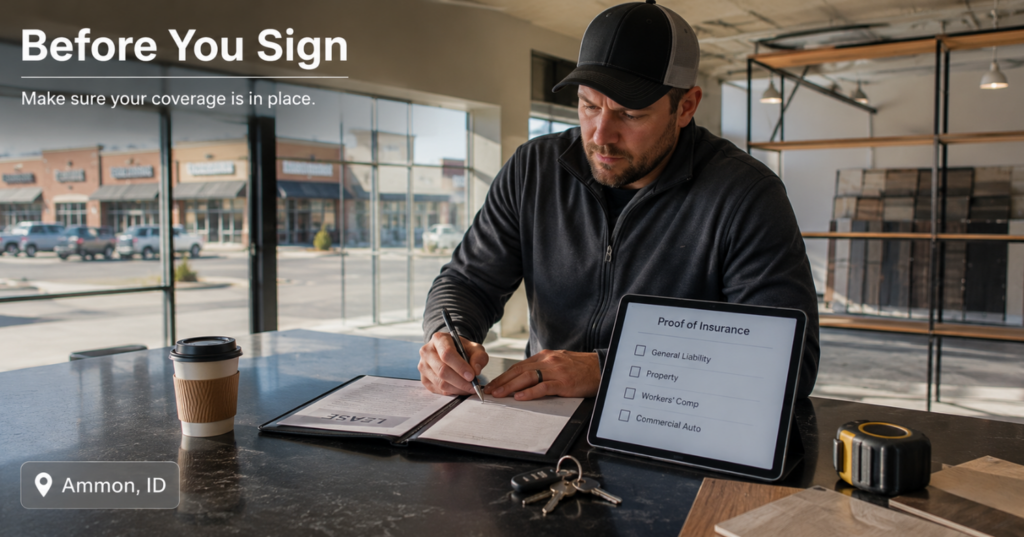
If your Idaho Falls small business has employees, workers’ compensation needs to be reviewed carefully.
The Idaho Industrial Commission states that employers with one or more full-time, part-time, seasonal, or occasional employees are required to maintain a workers’ compensation policy unless specifically exempt from the law. It also states that workers’ compensation must be in place before the first employee is hired.
This is one of the clearest examples of why business insurance should not wait until a problem happens.
If you hire your first employee, even part-time or seasonal, you may have a workers’ compensation responsibility. There are exemptions, so business owners should confirm how the rule applies to their specific situation.
What Workers’ Compensation Helps Address
Workers’ compensation is designed to help with work-related injuries or illnesses. The Idaho Industrial Commission describes workers’ compensation as a no-fault system that provides wage loss and medical benefits for workers with job-related injuries or diseases.
For business owners, this is not only about compliance. It is also about protecting employees and reducing risk when workplace injuries happen.
Ask:
- Do I have employees or only independent contractors?
- Are any workers seasonal, part-time, or occasional?
- Are any family members working in the business?
- Do I need to post notice of insurance coverage?
- Are there exemptions that apply to my business structure?
- Am I hiring soon?
The Idaho Industrial Commission also states that Idaho Code § 72-312 requires employers to post notice of insurance coverage in a conspicuous place at their places of business.
Because workers’ compensation rules can depend on the details, employers should review their situation before hiring.
Commercial Property Insurance: What Would It Cost to Replace What You Use Every Day?
Business owners often underestimate how much they rely on physical property.
That may include:
- Tools
- Inventory
- Computers
- Office furniture
- Equipment
- Machinery
- Signage
- Supplies
- Tenant improvements
- Business-owned buildings
- Point-of-sale systems
Commercial property insurance may help protect certain business property from covered events, depending on the policy.
For a small business in Idaho Falls, this can be especially important if one unexpected event would make it difficult to keep operating.
Ask yourself:
- What equipment would I need to replace immediately?
- Do I own or lease my space?
- Does my lease require property coverage?
- Is my inventory seasonal or high value?
- Are tools or equipment stored off-site or in vehicles?
- Could I operate without my current equipment?
- Do I know the replacement cost of my business property?
A simple inventory list can help. Take photos. Keep receipts when possible. Review whether your policy reflects what your business actually uses today, not what it used three years ago.
Commercial Auto: Personal Auto Insurance May Not Be Enough
Many small business owners use vehicles for work.
That may include:
- Driving to client appointments
- Visiting job sites
- Delivering products
- Transporting tools
- Running business errands
- Using employee vehicles for work purposes
- Operating trucks, vans, trailers, or specialty vehicles
A personal auto policy may not cover business use the way a business owner expects. Commercial auto insurance may be needed when vehicles are used for business purposes.
This is worth reviewing if:
- The vehicle is titled to the business
- Employees drive for work
- Tools or equipment are regularly transported
- The vehicle has business signage
- You use a truck, van, or trailer for business operations
- You deliver goods or visit customer sites
- Your personal vehicle is used heavily for business
Vehicle use is one of those areas where details matter. The policy should match how the vehicle is actually used.
Essential Insurance Coverage for Small Businesses in Idaho Falls
Some losses do not only damage property. They interrupt income.
Business interruption coverage may help replace lost income after certain covered events, depending on the policy. This type of coverage is often tied to property coverage and has specific rules, limits, and waiting periods.
A business owner should ask:
- If my business had to close for two weeks, could I cover expenses?
- What about two months?
- Would rent, payroll, loans, utilities, and vendor bills continue?
- Do I rely on one physical location?
- Could I operate remotely or temporarily from another place?
- What events are covered and excluded?
For Idaho Falls businesses with storefronts, equipment, inventory, or customer-facing operations, this conversation can be important.
Business interruption insurance is not the same as general slow sales. It usually applies only when a covered event interrupts operations. That is why policy language matters.
Group Health Plan Assistance: When Benefits Become Part of Business Planning
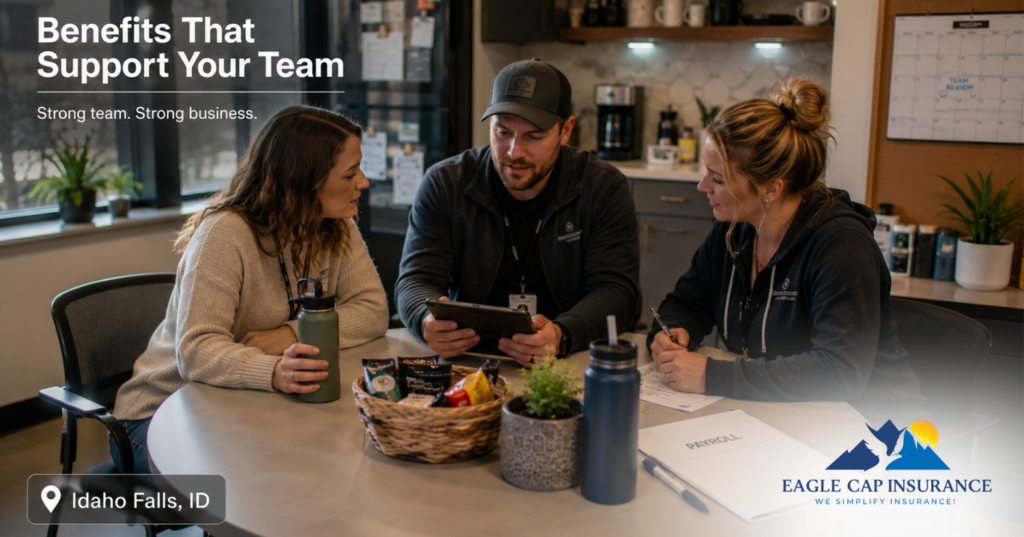
For many small employers, employee benefits are not just a nice extra. They can affect hiring, retention, morale, and competitiveness.
Health insurance costs remain a major concern for employers. KFF reported that annual premiums for employer-sponsored family health coverage reached $26,993 in 2025, up 6% from 2024. Workers contributed an average of $6,850 toward family coverage, and the average deductible among covered workers with a general annual deductible was $1,886 for single coverage.
NFIB has also described health insurance as a long-standing challenge for small business owners, stating that for nearly 40 years, NFIB members have consistently identified the rising cost of health insurance as their number one business concern.
For small business owners in Idaho Falls, this does not mean every business is ready for a group health plan. It means health benefits should be reviewed as part of the business plan when the time is right.
When to Ask About Group Health Plan Assistance
You may want to review group health options if:
- You have employees asking about benefits.
- You are competing for workers.
- You want to improve retention.
- You are trying to reduce turnover.
- You are growing from solo operator to employer.
- You want to understand group versus individual options.
- You are unsure what your business can afford.
- You need help comparing contribution strategies.
A local advisor can help explain available options, what information is needed, and how plan choices may affect both the business and employees.
Business Insurance and Benefits Are Connected
Many owners separate “business insurance” and “employee benefits” in their mind.
In real life, they often overlap.
A business owner may need liability coverage to protect the company, workers’ compensation to meet employer responsibilities, health plan assistance to support employees, and life or disability insurance to protect the people the business depends on.
Here is a practical way to think about it.
| Business Situation | Coverage Areas to Review | Why It Matters |
| You are a solo owner with no employees | General liability, property, commercial auto, disability insurance, life insurance | The business may depend heavily on your ability to work and serve clients. |
| You are hiring your first employee | Workers’ compensation, employment-related coverage, group health plan assistance | Idaho workers’ compensation rules may apply once employees are involved, unless exempt. |
| You work at customer locations | General liability, commercial auto, tools/equipment coverage | Client property, travel, tools, and job-site risk may need review. |
| You lease office or retail space | General liability, commercial property, lease-required coverage | Landlords often require proof of coverage, and business property may need protection. |
| You use vehicles for business | Commercial auto, hired/non-owned auto, liability coverage | Personal auto coverage may not match business vehicle use. |
| You have partners or key employees | Life insurance, disability insurance, buy-sell planning, key person coverage | The business may need a plan if an owner or key person dies or cannot work. |
| You want to retain employees | Group health plan assistance, supplemental benefits, employee benefit strategy | Benefits can affect hiring and retention decisions. |
This is why a business insurance review should look at the whole business, not just one policy.
Owner Life Insurance and Disability Insurance: Protecting the Business Behind the Business
Small businesses often depend on a few key people.
Sometimes that is the owner. Sometimes it is a spouse, partner, manager, technician, salesperson, or operations lead.
If that person died or could not work, the business could face immediate pressure.
Life insurance and disability insurance may help with business continuity, family protection, income protection, or buy-sell planning, depending on the policy and business structure.
Business owners should ask:
- What happens if I cannot work for three months?
- What happens if I die unexpectedly?
- Would my family be able to keep the business, sell it, or transition it?
- Do I have a business partner?
- Is there a buy-sell agreement?
- Would the business need cash to replace a key person?
- Does my income support both the business and my household?
- Do I have disability coverage outside of workers’ compensation?
This part of the conversation is often overlooked because owners are busy taking care of everyone else.
But for many small businesses, the owner is the engine. If the owner stops, the business may stop.
Common Mistakes Idaho Falls Business Owners Make With Insurance
Mistake 1: Waiting Until a Contract Requires Coverage
Many business owners look for insurance only when a landlord, lender, client, or general contractor asks for proof.
That creates pressure. It is better to review coverage before a deadline.
Mistake 2: Assuming One Policy Covers Everything
General liability does not replace workers’ compensation. Commercial auto does not replace property coverage. Health benefits do not replace owner disability coverage.
Each coverage has a different job.
Mistake 3: Not Reviewing Coverage After Hiring
Hiring employees can change the insurance conversation quickly.
In Idaho, employers with one or more full-time, part-time, seasonal, or occasional employees are required to maintain workers’ compensation unless exempt.
Mistake 4: Forgetting About Business Vehicle Use
Using a personal vehicle for business may create coverage issues. If driving is part of operations, review commercial auto.
Mistake 5: Ignoring Employee Benefits Until Turnover Becomes a Problem
Health benefits can become part of hiring and retention. With health insurance costs continuing to rise, business owners often need help comparing options and understanding what is realistic for their company.
Mistake 6: Not Updating Coverage as the Business Grows
A policy that made sense when you were a one-person business may not fit after you add employees, equipment, vehicles, contracts, or a physical location.
Questions to Ask Before Buying Business Insurance
Before choosing coverage, ask:
- What does my business actually do every day?
- Do customers visit my location?
- Do I work at client locations?
- Do I have employees?
- Am I hiring soon?
- Do I use vehicles for business?
- What property, tools, or equipment would be expensive to replace?
- Do I have contracts that require specific limits?
- Do I need certificates of insurance?
- Do I work with subcontractors or independent contractors?
- Does my lease require certain coverage?
- What would happen if my business had to close temporarily?
- Does my family depend on this business income?
- Do I need group health plan assistance?
- Do I have a plan if I cannot work?
These questions help turn insurance from a confusing checklist into a real business planning conversation.
Why Local Guidance Matters for Idaho Falls and Ammon Businesses
Business insurance is not just about picking a policy online.
Local context matters because business owners in Idaho Falls, Ammon, Iona, Ucon, and Eastern Idaho often operate in relationship-driven communities. You may know your customers. You may work with local landlords, contractors, lenders, vendors, and employees. A coverage gap can affect not only your finances, but also your reputation and ability to keep serving people.
Eagle Cap Insurance – Idaho Falls is located at 919 S 25th E, Suite 130, Ammon, ID 83406 and helps business owners review coverage options, ask better questions, and compare business insurance needs in plain English.
A local advisor can help you think through:
- General liability insurance
- Business insurance
- Group health plan assistance
- Business health plan assistance
- Disability insurance
- Life insurance for business owners
- Buy-sell planning
- Employee benefit questions
- Insurance consultation and review
The goal is not to overcomplicate the process. The goal is to help you understand what risks are worth reviewing now, what can wait, and what may be required because of employees, contracts, leases, or business operations.
When Should a Small Business Review Insurance?
A business insurance review is especially useful when:
- You start a business
- You sign or renew a lease
- You buy equipment
- You hire your first employee
- You add part-time or seasonal help
- You start using vehicles for work
- You take on larger contracts
- A client asks for proof of insurance
- You add a partner
- You take out a business loan
- You move locations
- You begin offering employee benefits
- Your revenue increases
- Your business model changes
- You have not reviewed coverage in the last year
A yearly review is a good habit. A major business change is a good reason to review sooner.
Frequently Asked Questions
What insurance does a small business in Idaho Falls need?
The right coverage depends on the business. Many small businesses review general liability insurance, commercial property insurance, workers’ compensation, commercial auto, business interruption, life insurance, disability insurance, and group health plan assistance.
Is general liability insurance required in Idaho?
General liability insurance is commonly required by landlords, lenders, vendors, or client contracts, but requirements depend on the business situation. It is still one of the first coverages many business owners review because it may help with certain injury, property damage, and legal defense claims.
Is workers’ compensation required for Idaho businesses?
The Idaho Industrial Commission states that employers with one or more full-time, part-time, seasonal, or occasional employees are required to maintain workers’ compensation unless specifically exempt by law. Coverage must be in place before the first employee is hired.
Do I need business insurance if I work from home?
A home-based business may still need coverage depending on the work performed, equipment used, client interaction, business property, contracts, and liability exposure. Homeowners insurance may not cover business activities the way an owner expects.
Does my small business need commercial auto insurance?
If vehicles are used for business purposes, commercial auto should be reviewed. This may include visiting job sites, delivering products, transporting tools, or having employees drive for work.
When should I ask about group health plan assistance?
You may want group health plan assistance when you have employees, want to improve retention, are competing for workers, or want to understand whether health benefits are realistic for your business.
Can Eagle Cap Insurance help with business insurance in Idaho Falls?
Yes. Eagle Cap Insurance – Idaho Falls helps local business owners review business insurance options, general liability insurance, group health plan assistance, life insurance, disability insurance, and related coverage needs.
How often should small business owners review insurance?
Many business owners benefit from reviewing insurance at least once a year or whenever the business changes. Hiring employees, adding vehicles, signing contracts, moving locations, or offering benefits are all good reasons to review coverage.
Final Takeaway
Small business insurance is not about buying the most policies.
It is about understanding what could realistically affect your business, your employees, your customers, your income, and your family.
For Idaho Falls and Ammon business owners, the most important coverage areas to review often include general liability insurance, workers’ compensation, property coverage, commercial auto, business interruption, group health plan assistance, life insurance, and disability insurance.
The right mix depends on your business structure, employees, contracts, vehicles, property, and goals.
Eagle Cap Insurance – Idaho Falls helps small business owners in Idaho Falls, Ammon, Iona, Ucon, and Eastern Idaho review insurance options in a practical, plain-English way.
Schedule an appointment with Eagle Cap Insurance – Idaho FallsCall: +1 208 529 1522
Visit the Idaho Falls / Ammon location page
Disclaimer: This article is for general educational purposes only and does not replace personalized insurance, legal, financial, or tax advice. Coverage options, eligibility, policy features, exclusions, limits, requirements, and costs can vary.