








Health insurance has a reputation for being confusing, but the core ideas are simpler than the jargon suggests. If you understand a handful of terms and how they fit together, you can choose a plan with confidence instead of guesswork. This is a plain‑English primer for Idaho residents on how health insurance actually works.
How Health Insurance Works
You pay a monthly premium to keep coverage active. When you need care, you share the cost with your insurer through a deductible (what you pay before the plan kicks in), then copays or coinsurance (your share after that), up to an out‑of‑pocket maximum — the most you’ll pay in a year, after which the plan covers 100%. Those five terms explain almost every plan.
The Terms That Matter
- Premium — your monthly cost, paid no matter what.
- Deductible — what you pay before cost‑sharing begins.
- Copay — a flat fee for a service (e.g., $30 a visit).
- Coinsurance — your percentage share after the deductible.
- Out‑of‑pocket maximum — your annual ceiling and financial safety net.

Plan Types & Networks
Plans differ mainly in their network rules. An HMO keeps you in‑network and often needs referrals (lower cost, less flexibility); a PPO offers out‑of‑network flexibility (more cost, more choice). Marketplace plans also come in metal tiers — Bronze, Silver, Gold — trading premium against out‑of‑pocket cost. Whatever the type, confirm your doctors and prescriptions are in‑network before choosing; it’s the single most important check.
Where Idahoans Get Coverage
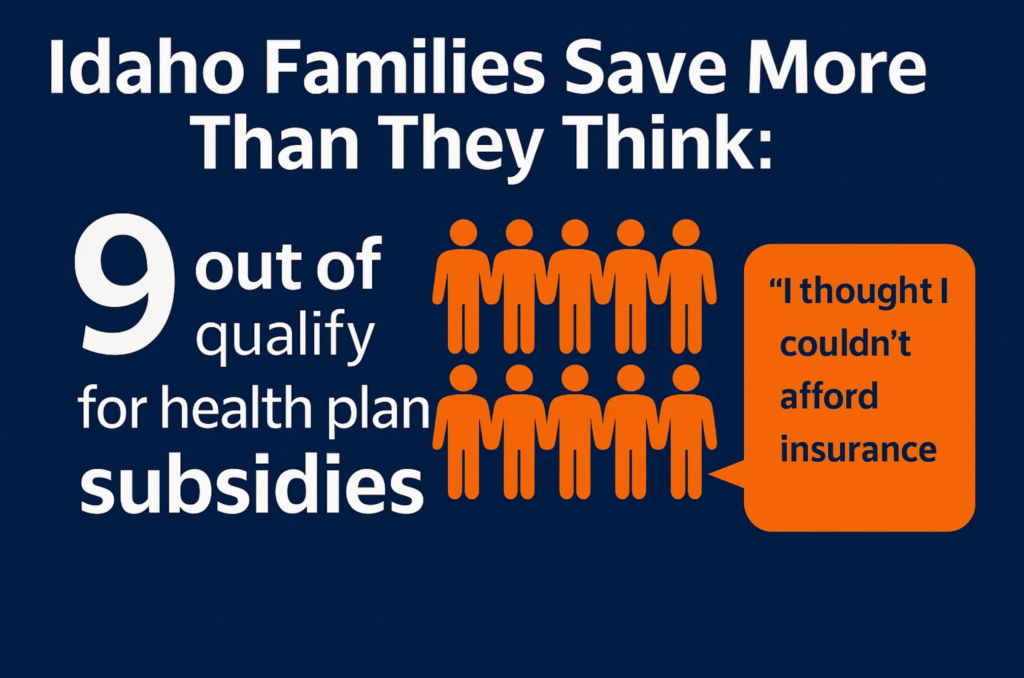
Most individuals and families buy through Your Health Idaho, the state marketplace and the only place to use a premium tax credit. Others get coverage through an employer, or through Medicaid/CHIP if income‑eligible. Many Idahoans qualify for subsidies that lower the monthly cost significantly — and don’t realize it.

How to Choose a Plan
- Compare total cost — premium plus expected out‑of‑pocket, not premium alone.
- Confirm your network — your doctors, hospital, and pharmacy.
- Check your prescriptions against each plan’s drug list.
- Check for a subsidy — it can change the math entirely.
If that feels like a lot, it’s exactly what a local agent does for free.
Get Plain‑English Help
You don’t have to learn all of this alone. As an independent agency, we explain your options without jargon, compare plans across carriers and the marketplace, check your subsidy and network, and help you enroll — at no cost to you. Explore more on our health insurance page.
Frequently Asked Questions
What is the difference between a premium and a deductible?
A premium is what you pay each month to keep coverage active. A deductible is what you pay out of pocket for covered care before the plan starts sharing costs. You pay the premium whether or not you use care.
Where do Idaho residents buy health insurance?
Most individuals buy through Your Health Idaho, the state marketplace, which is the only place to use a premium tax credit. Coverage may also come from an employer, Medicaid/CHIP, or Medicare.
What is a provider network?
A network is the group of doctors, hospitals, and pharmacies that contract with your plan for lower rates. Staying in-network keeps your costs down; going out-of-network usually costs much more.
How do I choose the right health plan?
Compare total cost (premium plus expected out-of-pocket), confirm your doctors and prescriptions are covered, and check whether you qualify for a subsidy. A local agent can do this comparison for you for free.
Call (208) 529-1522 or visit eaglecapinsurance.com/contact and we’ll walk you through health insurance in plain language, check your subsidy, and find a plan that fits — free and local.
About the author — Kyle Bennett, Principal & Licensed Insurance Agent, Eagle Cap Insurance, Ammon, ID. Kyle is a licensed independent insurance agent and the principal of Eagle Cap Insurance, explaining health coverage in plain English for Idahoans, serving eastern Idaho from Idaho Falls (Ammon) and Preston.