







Accident insurance pays specified cash benefits for covered injuries and treatments. It can help with expenses under a high-deductible health plan, but it doesn’t replace that plan. Whether it’s worth buying depends on the premium, covered benefits, your deductible and the savings you could use after an injury.
Families considering bronze coverage often want a lower monthly premium but are concerned about the deductible. An unexpected injury can leave a substantial bill even when they have health insurance.
For some families, I compare a bronze plan with an accident policy alongside other options. I’ve described that approach as “for minimal dollars… an accident plan that pays out X amount… matched up with your deductible,” particularly for “young clients with lots of kids in sports.” The actual premium and benefit schedule need to justify the extra policy.
Open enrollment through Your Health Idaho runs October 15 to December 15, 2026, for coverage starting January 1, 2027. That’s earlier than the HealthCare.gov dates in national news. Idaho has no January window.
What is accident insurance, and what isn’t it?
Accident insurance pays a set cash amount for specific injuries and treatments listed in the policy, no matter what the hospital actually charges. An ER visit, an X-ray, a fracture, a dislocation, an ambulance ride: each has its own line on a schedule. The money usually goes to you, not the provider, and you decide what to spend it on.
Before buying, understand these limits:
- It isn’t health insurance. Accident plans don’t count as ACA health insurance, and federal rules classify their close cousin, fixed indemnity coverage, as an “excepted benefit” rather than comprehensive coverage (2024 final rule, 89 FR 23338). An accident plan won’t pay for a cancer diagnosis, a pregnancy or a prescription you take every month.
- It isn’t sold through Your Health Idaho, and Marketplace tax credits don’t apply to it.
- It doesn’t count as coverage when coverage matters. If you move to Idaho and need a special enrollment period, you generally need at least one day of qualifying health coverage in the 60 days before the move. An accident plan on its own won’t get you there.
Accident coverage is sometimes presented alongside hospital indemnity or other fixed indemnity policies. They aren’t interchangeable with comprehensive health insurance. For individual fixed indemnity coverage starting on or after January 1, 2025, insurers must include a federal notice in at least 14-point type on the first page of marketing, application, enrollment and policy documents. Read that notice and the benefit schedule to understand what the policy covers.
Why does a high deductible change the math?
With a high deductible, you may be responsible for several thousand dollars before the health plan pays its share. An accident policy’s cash benefits can help with covered injuries, although the benefit may be smaller than the bill. A low-deductible health plan leaves less of that expense to cover.
Two developments are relevant when comparing 2027 coverage:
Bronze plans can now pair with a Health Savings Account. Starting with 2026 plans, a 2025 federal law treats Marketplace bronze and catastrophic plans as HSA-eligible, even when they miss the usual high-deductible plan rules (IRS Notice 2026-5). For 2027 you can put up to $4,500 into an HSA for self-only coverage or $9,000 for a family, plus $1,000 more if you’re 55 or older. Before you open one, confirm your specific plan with us or a tax professional.
Review the out-of-pocket maximum. The standard 2027 Marketplace maximum is $12,000 for one person and $24,000 for a family for covered in-network care. Check the actual limit on each plan rather than looking only at the deductible.
The following example uses hypothetical figures to illustrate how benefits might offset expenses. It isn’t a quote or an insurer’s benefit schedule:
- Your family is on a bronze plan with a $6,000 deductible per person.
- Your 13-year-old breaks a wrist at a weekend tournament. ER, X-rays, a cast, two follow-ups.
- Most of that bill lands inside the deductible, so you pay it.
- Your accident plan’s schedule pays, say, $1,500 across the ER, fracture and follow-up lines. That check comes to you.
- You put it toward the hospital bill. Your HSA, if you’ve funded it, covers more. What’s left is yours.
The cash benefit reduces the family’s expense in this example; it doesn’t cover the entire $6,000 bill.

Who is accident insurance worth it for?
Consider accident coverage if your deductible is high, your household faces a meaningful risk of injury and a surprise bill would strain your savings. Compare the premium with the benefits before deciding whether the additional policy is useful.
Where I see it fit:
- Families with kids in sports. Football, wrestling, rodeo, dance, skiing at Kelly Canyon. Kids get hurt, and the deductible doesn’t care that it was a “small” injury.
- Bronze or HSA households without much saved yet. If the HSA balance is low, cash from an accident claim fills the hole while the account builds.
- Physically active adults. Ranch work, trades, construction, weekend riders.
Where it usually doesn’t:
- Low-deductible plans. If your deductible is already small, you’re paying a premium to cover a gap you don’t really have.
- Silver plans with cost-sharing reductions. If your income lets you get the stronger silver plans through Your Health Idaho, the 2027 out-of-pocket maximum on the 94% and 87% versions drops to $4,000 for one person and $8,000 for a family. There’s far less exposure to protect.
- Anyone using it instead of health insurance. There’s no federal or Idaho tax penalty for going uninsured anymore, but an accident plan won’t touch the bills from an illness. That’s the gamble people don’t see coming.
Accident plan, HSA, or a lower deductible: how do they compare?
These options address medical expenses differently:
| Option | How it handles an injury | Best for | The tradeoff |
|---|---|---|---|
| Bronze plan + accident plan | Pays fixed cash per covered injury toward your deductible | Active families who want a low health premium | Extra premium; only injuries, not illness |
| Bronze plan + funded HSA | You pay the deductible with tax-advantaged money you saved | People who can set money aside each month | Works only as well as your balance |
| Bronze + HSA + accident plan | Accident cash covers part; the HSA covers more | Big families, sports-heavy households | Two things to manage and pay for |
| Silver or gold plan | A lower deductible means less to cover in the first place | Ongoing care needs, or CSR-eligible incomes on silver | Higher monthly health premium |
Compare the total premiums, benefits and savings available to your household. No single option fits every family.

How do I match an accident plan to my deductible?
Choose the health plan first. Then review whether an accident policy would cover expenses you’re concerned about, using the actual benefit schedule and exclusions.
I work through these items with a family:
- Choose the health plan first. We look at your household, your income and your tax credit, and I lay out a bronze, a silver and a gold option. Once you’ve picked, we know the deductible and the out-of-pocket maximum.
- Picture the likely injury, not the worst one. For most families that’s a fracture, stitches, an ER night or a sprain that needs imaging. The catastrophic year is what your out-of-pocket maximum is for.
- Read the schedule against that injury. Add up what the plan would pay for the ER, imaging, fracture and follow-up lines. Compare it to your deductible. If it covers a meaningful slice for a modest premium, it’s doing its job.
- Check the fine print that changes the payout. Is it 24-hour coverage or off-the-job only? Does it pay for urgent care, or only the ER? Are kids covered to a certain age? (Check that one twice if you have teenagers.) Is there a waiting period?
- Look for the notice. If the plan is bundled with hospital or fixed indemnity coverage, the federal notice should be on the first page. If it’s missing from an individual plan, ask why.
- Decide. You’ll live with the deductible, so it’s your call. My job is to make sure you understand the risk on each side.
If the bigger worry is the paycheck that stops while you recover, that’s a different product. Our guide to health insurance vs. disability insurance in Idaho explains why medical bills and lost income need separate coverage.
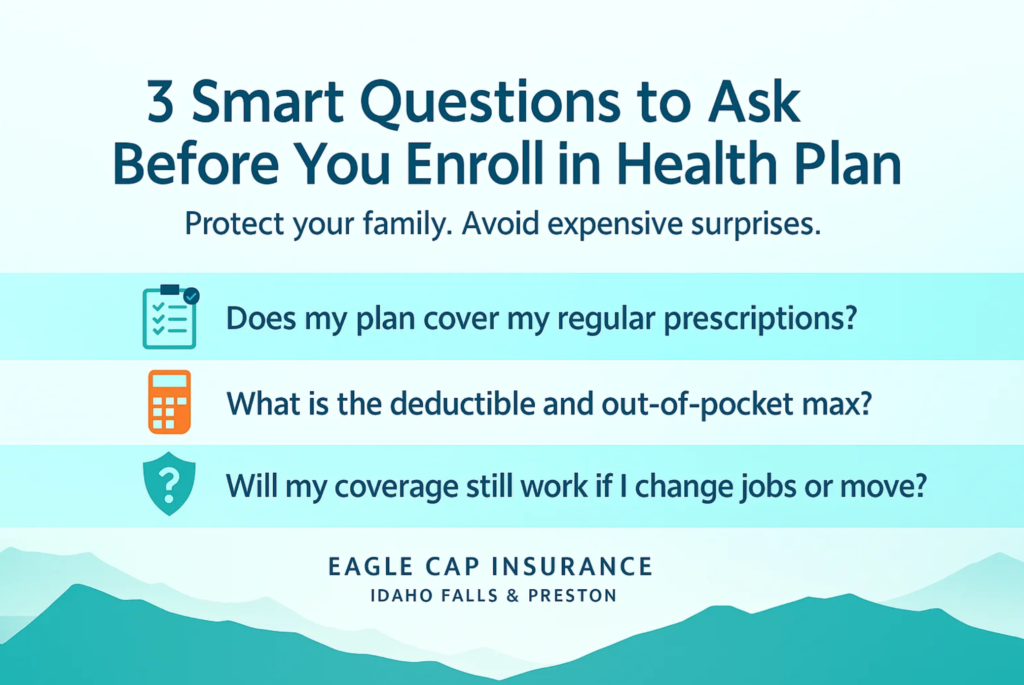
What should I ask before I buy?
Ask these questions and check the answers against the policy documents:
- What’s on the schedule, and what does each line pay? Get it in writing.
- Does it pay for illness at all? Usually not. Make sure you’re not expecting it to.
- Is it guaranteed issue, or are there health questions? Terms vary by insurer.
- How do claims work? Some want the ER records; some want a claim form from the doctor. Ask before you need it.
If you’re still choosing the health plan underneath it, start with our Idaho open enrollment guide and our walkthrough on how to compare health insurance plans in Idaho.
Frequently Asked Questions
Is accident insurance the same as health insurance?
No. Accident insurance pays fixed cash amounts for covered injuries. It does not count as ACA health insurance, and it does not replace a major medical plan. Think of it as a supplement that sits next to your health plan.
Can I buy accident insurance through Your Health Idaho?
No. Your Health Idaho sells ACA health plans. Accident plans are sold separately by insurers, and Marketplace premium tax credits do not apply to them. We can help you shop both, but they are two separate purchases.
Does accident insurance pay if I get sick?
Generally no. An accident plan pays for injuries from covered accidents, like a fracture or a dislocation, not for illnesses like the flu or a chronic condition. Read the policy’s definitions, because what counts as a covered accident is set by the contract.
When is the best time to add accident insurance?
The easiest time is when you pick your health plan, because that is when you know your new deductible. In Idaho, open enrollment for 2027 coverage runs October 15 through December 15, 2026, with plans starting January 1, 2027. Accident plans follow the insurer’s own rules, so ask us about timing if you are adding one at another point in the year.
If you’re considering accident coverage alongside a bronze plan, bring us the plan details. We can compare the benefit schedule with your deductible and other options before you buy. Our overview of health insurance options in Idaho can also help you prepare.
This article is general education, not insurance or tax advice, and not an offer of coverage. Accident and fixed indemnity plans are not health insurance and do not replace ACA coverage. Benefits, eligibility and terms vary by insurer and policy, so talk with a licensed agent about your situation and a tax professional before opening an HSA.
About the author:
Kyle leads Eagle Cap Insurance, an independent agency serving eastern Idaho since 2008 from offices in Ammon (Idaho Falls area) and Preston. He works with dozens of carriers to help families and employers with health, life, disability and business benefits.